Skip to main content
Microbiology
나의 코스
배우기
시험 준비
AI 튜터
학습 가이드
교과서적 해결책
플래시카드
탐험해 보세요
앱을 사용해 보세요
나의 코스
배우기
시험 준비
AI 튜터
학습 가이드
교과서적 해결책
플래시카드
탐험해 보세요
앱을 사용해 보세요
뒤로
Chargaff's Rules quiz
카드를 뒤집기 위해 탭할 수 있습니다.
Who was the scientist that made two key discoveries about DNA in the early 1950s?
카드를 뒤집기 위해 탭할 수 있습니다.
👆
Who was the scientist that made two key discoveries about DNA in the early 1950s?
Erwin Chargaff made two key discoveries about DNA in the early 1950s.
진행 상황 추적
컨트롤 버튼이 '내비게이션' 모드로 변경되었습니다.
1/15
관련 플래시카드
관련 실천
추천 영상
Chargaff's Rules definitions
Chargaff's Rules
14 용어
Chargaff's Rules
14. DNA Replication
3 문제점
주제
Nicole
Discovering the Structure of DNA
14. DNA Replication
3 문제점
주제
Nicole
14. DNA Replication
10 주제
14 문제점
장
Brendan
04:33
Chargaff's Rules
12289
views
144
rank
이 집합의 용어 (15)
하이드의 정의
Who was the scientist that made two key discoveries about DNA in the early 1950s?
Erwin Chargaff made two key discoveries about DNA in the early 1950s.
What does Chargaff's first rule state about DNA base composition among species?
Chargaff's first rule states that DNA base composition varies among different species.
According to Chargaff's second rule, which DNA bases are present in roughly equal amounts in any species?
Adenine (A) is roughly equal to thymine (T), and guanine (G) is roughly equal to cytosine (C) in any species.
Why are the percentages of A and T, and G and C, roughly equal in DNA?
Because A pairs with T and G pairs with C through complementary base pairing in DNA.
What was unknown at the time of Chargaff's discoveries that made his findings so important?
The structure of DNA was unknown, so Chargaff's findings were crucial for understanding it.
How did Chargaff's data contribute to future research on DNA?
Chargaff's rules laid the groundwork for future research on the structure of DNA.
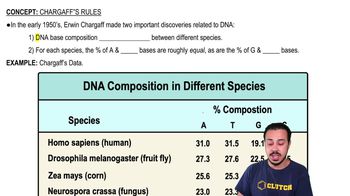
What did Chargaff observe about the DNA base composition in Homo sapiens compared to Escherichia coli?
He observed that the DNA base composition, or percentages of A, T, G, and C, varies between Homo sapiens and Escherichia coli.
Why are the percentages of A and T, and G and C, not exactly equal in Chargaff's data?
Slight discrepancies are due to limitations in Chargaff's experimental techniques.
What are the approximate percentages of A and T in human DNA according to Chargaff's data?
In humans, the percentage of A and T is roughly around 31% each.
What are the approximate percentages of G and C in human DNA according to Chargaff's data?
In humans, the percentage of G and C is roughly around 19% and 18% respectively.
Does the rule that A equals T and G equals C apply to all species?
Yes, Chargaff found that this rule applies to all species he studied.
What are the four nitrogenous bases found in DNA?
The four nitrogenous bases in DNA are adenine (A), thymine (T), guanine (G), and cytosine (C).
What did Chargaff's first discovery reveal about the uniqueness of species?
It revealed that each species has a unique DNA base composition.
How did Chargaff's findings help in revealing the structure of DNA?
His findings about base pairing ratios were critical clues that helped scientists deduce the double helix structure of DNA.
What is the main reason for slight differences in the percentages of complementary bases in Chargaff's data?
The main reason is the limitations in the experimental techniques available to Chargaff at the time.
 뒤로뒤로
뒤로뒤로
 04:33
04:33