Skip to main content
Microbiology
나의 코스
배우기
시험 준비
AI 튜터
학습 가이드
교과서적 해결책
플래시카드
탐험해 보세요
앱을 사용해 보세요
나의 코스
배우기
시험 준비
AI 튜터
학습 가이드
교과서적 해결책
플래시카드
탐험해 보세요
앱을 사용해 보세요
뒤로
Classes of Antibodies definitions
카드를 뒤집기 위해 탭할 수 있습니다.
Immunoglobulin
카드를 뒤집기 위해 탭할 수 있습니다.
👆
Immunoglobulin
A protein produced by B cells that recognizes and binds specific antigens, forming the basis of antibody-mediated immunity.
진행 상황 추적
컨트롤 버튼이 '내비게이션' 모드로 변경되었습니다.
1/15
관련 플래시카드
관련 실천
추천 영상
Classes of Antibodies quiz
Classes of Antibodies
15 용어
Classes of Antibodies
20. Adaptive Immunity
8 문제점
주제
Nicole
Outcomes of Antibody Binding to Antigen
20. Adaptive Immunity
7 문제점
주제
Nicole
20. Adaptive Immunity - Part 1 of 3
7 주제
12 문제점
장
Brendan
20. Adaptive Immunity - Part 2 of 3
6 주제
13 문제점
장
Brendan
20. Adaptive Immunity - Part 3 of 3
7 주제
13 문제점
장
Brendan
02:45
IgE
1239
views
10
rank
02:44
IgA
1252
views
14
rank
04:43
Classes of Antibodies
2724
views
27
rank
이 집합의 용어 (15)
하이드의 정의
Immunoglobulin
A protein produced by B cells that recognizes and binds specific antigens, forming the basis of antibody-mediated immunity.
IgG
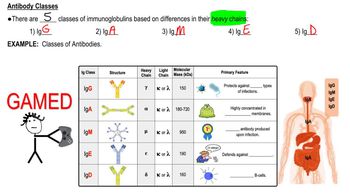
The most abundant antibody in blood and tissues, capable of crossing the placenta to provide newborn immunity and activating the complement system.
IgA
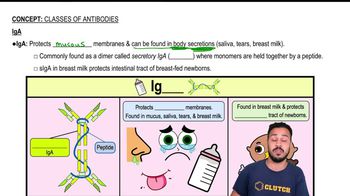
A dimeric antibody found in mucus, saliva, tears, and breast milk, crucial for protecting mucosal surfaces and infant intestines.
IgM
A pentameric antibody, largest in size, first produced during infection, highly effective at activating the complement system in blood.
IgE
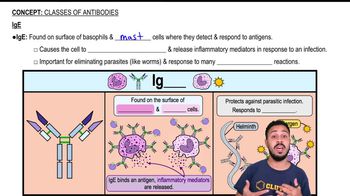
An antibody found on basophils and mast cells, triggers degranulation, central to allergic reactions and defense against parasites.
IgD
A monomeric antibody on B cell surfaces, essential for B cell activation and maturation into plasma cells during immune responses.
Heavy Chain
The unique protein component of an antibody that determines its class and functional properties.
Light Chain
A protein segment identical across all antibody classes, not involved in distinguishing antibody types.
Dimer
A molecular structure formed by two identical antibody units, characteristic of secretory IgA.
Pentamer
A structure composed of five antibody subunits, giving IgM its large size and high antigen-binding capacity.
Plasma Cell
A differentiated B cell specialized in secreting large quantities of antibodies during immune responses.
Complement System
A cascade of proteins activated by antibodies like IgG and IgM, leading to pathogen destruction via inflammation and cell lysis.
Degranulation
The process where basophils or mast cells release granule contents, often triggered by IgE during allergic responses.
Placental Transfer
The movement of maternal antibodies, especially IgG, across the placenta to provide fetal and newborn immunity.
Mucus Membrane
A tissue lining body passages, protected by IgA antibodies against pathogens in secretions like saliva and tears.
 뒤로뒤로
뒤로뒤로
 02:45
02:45