Skip to main content
Microbiology
나의 코스
배우기
시험 준비
AI 튜터
학습 가이드
교과서적 해결책
플래시카드
탐험해 보세요
앱을 사용해 보세요
나의 코스
배우기
시험 준비
AI 튜터
학습 가이드
교과서적 해결책
플래시카드
탐험해 보세요
앱을 사용해 보세요
뒤로
Covalent Bonds quiz
카드를 뒤집기 위해 탭할 수 있습니다.
What is a covalent bond?
카드를 뒤집기 위해 탭할 수 있습니다.
👆
What is a covalent bond?
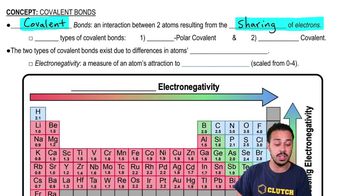
A covalent bond is an interaction between two atoms that results from the sharing of electrons.
진행 상황 추적
컨트롤 버튼이 '내비게이션' 모드로 변경되었습니다.
1/15
관련 플래시카드
관련 실천
추천 영상
Covalent Bonds definitions
Covalent Bonds
15 용어
Covalent Bonds
3. Chemical Principles of Microbiology
4 문제점
주제
Monica
Noncovalent Bonds
3. Chemical Principles of Microbiology
3 문제점
주제
Monica
3. Chemical Principles of Microbiology
7 주제
12 문제점
장
Nicole
04:28
Covalent Bonds
27701
views
540
rank
06:51
Polar Covalent Bonds
21901
views
368
rank
06:41
Nonpolar Covalent Bonds
23022
views
421
rank
이 집합의 용어 (15)
하이드의 정의
What is a covalent bond?
A covalent bond is an interaction between two atoms that results from the sharing of electrons.
What does the term 'covalent' mean in chemistry?
The term 'covalent' refers to the sharing of electrons between atoms.
What are the two main types of covalent bonds?
The two main types of covalent bonds are nonpolar covalent bonds and polar covalent bonds.
What is electronegativity?
Electronegativity is a measure of an atom's attraction to electrons, or how hard it pulls on electrons.
How does electronegativity change across the periodic table?
Electronegativity increases from left to right and from bottom to top on the periodic table.
What characterizes a nonpolar covalent bond?
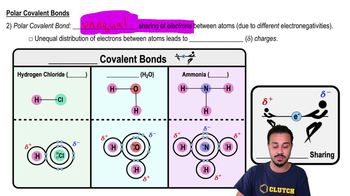
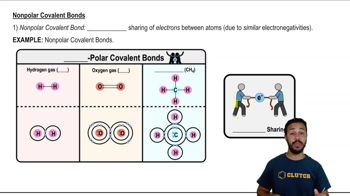
A nonpolar covalent bond is characterized by the equal sharing of electrons between atoms.
Why do nonpolar covalent bonds share electrons equally?
Nonpolar covalent bonds share electrons equally because the atoms involved have similar or identical electronegativities.
Give an example of a molecule with nonpolar covalent bonds.
Hydrogen gas (H2), oxygen gas (O2), and methane (CH4) are examples of molecules with nonpolar covalent bonds.
What characterizes a polar covalent bond?
A polar covalent bond is characterized by the unequal sharing of electrons between atoms.
Why do polar covalent bonds share electrons unequally?
Polar covalent bonds share electrons unequally because the atoms involved have different electronegativities.
What is the result of unequal sharing of electrons in polar covalent bonds?
Unequal sharing of electrons leads to partial charges on the atoms involved, with the more electronegative atom gaining a partial negative charge.
What symbol is used to indicate a partial charge in polar covalent bonds?
The Greek symbol delta (δ) is used to indicate a partial charge.
Give an example of a molecule with polar covalent bonds.
Water (H2O), hydrogen chloride (HCl), and ammonia (NH3) are examples of molecules with polar covalent bonds.
Which atom is more electronegative: oxygen or hydrogen?
Oxygen is much more electronegative than hydrogen.
What happens to the electron distribution in a polar covalent bond?
In a polar covalent bond, electrons spend more time with the more electronegative atom, creating partial negative and positive charges.
 뒤로뒤로
뒤로뒤로
 04:28
04:28