Skip to main content
Microbiology
나의 코스
배우기
시험 준비
AI 튜터
학습 가이드
교과서적 해결책
플래시카드
탐험해 보세요
앱을 사용해 보세요
나의 코스
배우기
시험 준비
AI 튜터
학습 가이드
교과서적 해결책
플래시카드
탐험해 보세요
앱을 사용해 보세요
뒤로
Cyclic vs. Non-Cyclic Photophosphorylation quiz
카드를 뒤집기 위해 탭할 수 있습니다.
What is photophosphorylation?
카드를 뒤집기 위해 탭할 수 있습니다.
👆
What is photophosphorylation?
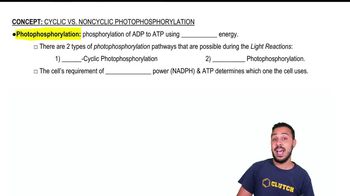
Photophosphorylation is the process of phosphorylating ADP to ATP using the energy of sunlight during the light reactions of photosynthesis.
진행 상황 추적
컨트롤 버튼이 '내비게이션' 모드로 변경되었습니다.
1/15
관련 플래시카드
관련 실천
추천 영상
Cyclic vs. Non-Cyclic Photophosphorylation definitions
Cyclic vs. Non-Cyclic Photophosphorylation
13 용어
Cyclic vs. Non-Cyclic Photophosphorylation
13. Photosynthesis
3 문제점
주제
Monica
Calvin Cycle
13. Photosynthesis
3 문제점
주제
Brendan
13. Photosynthesis
9 주제
13 문제점
장
Nicole
03:57
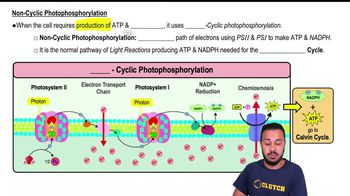
Non-Cyclic Photophosphorylation
1589
views
19
rank
04:36
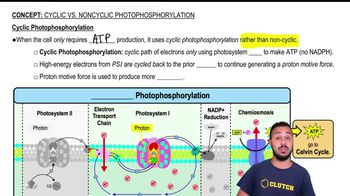
Cyclic Photophosphorylation
1353
views
12
rank
02:06
Cyclic vs. Non-Cyclic Photophosphorylation
2180
views
15
rank
이 집합의 용어 (15)
하이드의 정의
What is photophosphorylation?
Photophosphorylation is the process of phosphorylating ADP to ATP using the energy of sunlight during the light reactions of photosynthesis.
What are the two types of photophosphorylation pathways?
The two types are non-cyclic photophosphorylation and cyclic photophosphorylation.
Which pathway produces both ATP and NADPH?
Non-cyclic photophosphorylation produces both ATP and NADPH.
When does a cell use the non-cyclic photophosphorylation pathway?
A cell uses non-cyclic photophosphorylation when it requires both ATP and NADPH.
What is the path of electrons in non-cyclic photophosphorylation?
Electrons move in a linear path from photosystem II to photosystem I and finally to NADPH.
What is the main product of cyclic photophosphorylation?
The main product of cyclic photophosphorylation is ATP.
Which photosystem is used in cyclic photophosphorylation?
Cyclic photophosphorylation uses only photosystem I.
Does cyclic photophosphorylation produce NADPH?
No, cyclic photophosphorylation does not produce NADPH.
How do electrons move in cyclic photophosphorylation?
Electrons cycle from photosystem I back to the electron transport chain and then return to photosystem I.
What determines whether a cell uses cyclic or non-cyclic photophosphorylation?
The cell's need for ATP and NADPH determines which pathway is used; both are made in non-cyclic, while only ATP is made in cyclic.
What is the role of the proton motive force in photophosphorylation?
The proton motive force is used to generate ATP from ADP during both cyclic and non-cyclic photophosphorylation.
Where are the electrons ultimately transferred in non-cyclic photophosphorylation?
In non-cyclic photophosphorylation, electrons are ultimately transferred to NADP+ to form NADPH.
What happens to the hydrogen ion gradient during photophosphorylation?
A hydrogen ion gradient is built up in the thylakoid space, which drives ATP synthesis.
Can a cell switch between cyclic and non-cyclic photophosphorylation?
Yes, a cell can switch between the two pathways depending on its energy and reducing power needs.
What is the main difference in electron flow between cyclic and non-cyclic photophosphorylation?
Non-cyclic photophosphorylation has a linear electron flow, while cyclic photophosphorylation has a cyclic electron flow.
 뒤로뒤로
뒤로뒤로
 03:57
03:57