Skip to main content
Microbiology
나의 코스
배우기
시험 준비
AI 튜터
학습 가이드
교과서적 해결책
플래시카드
탐험해 보세요
앱을 사용해 보세요
나의 코스
배우기
시험 준비
AI 튜터
학습 가이드
교과서적 해결책
플래시카드
탐험해 보세요
앱을 사용해 보세요
뒤로
Discovering the Structure of DNA quiz
카드를 뒤집기 위해 탭할 수 있습니다.
What technique did Rosalind Franklin use to capture photo 51?
카드를 뒤집기 위해 탭할 수 있습니다.
👆
What technique did Rosalind Franklin use to capture photo 51?
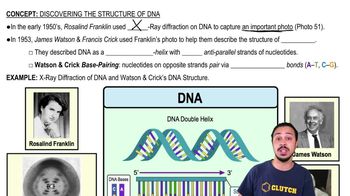
Rosalind Franklin used x-ray diffraction to capture photo 51.
진행 상황 추적
컨트롤 버튼이 '내비게이션' 모드로 변경되었습니다.
1/15
관련 플래시카드
관련 실천
추천 영상
Discovering the Structure of DNA definitions
Discovering the Structure of DNA
15 용어
Discovering the Structure of DNA
14. DNA Replication
3 문제점
주제
Nicole
Meselson-Stahl Experiment
14. DNA Replication
3 문제점
주제
Brendan
14. DNA Replication
10 주제
14 문제점
장
Brendan
06:24
Detailed DNA Structure
13257
views
171
rank
04:41
Discovering the Structure of DNA
14064
views
165
rank
이 집합의 용어 (15)
하이드의 정의
What technique did Rosalind Franklin use to capture photo 51?
Rosalind Franklin used x-ray diffraction to capture photo 51.
What key structural feature of DNA did photo 51 provide evidence for?
Photo 51 provided evidence that DNA has a double helix structure.
Who used Franklin's photo 51 to help describe the structure of DNA?
James Watson and Francis Crick used Franklin's photo 51 to help describe the structure of DNA.
How did Watson and Crick describe the arrangement of DNA strands?
Watson and Crick described DNA as having two antiparallel strands of nucleotides.
What does 'antiparallel' mean in the context of DNA structure?
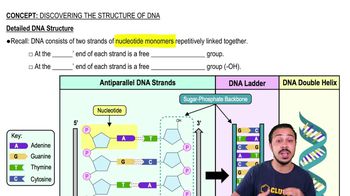
Antiparallel means that the two DNA strands run in opposite directions: one from 5' to 3' and the other from 3' to 5'.
What are the base pairing rules established by Watson and Crick?
Adenine (A) pairs with thymine (T), and cytosine (C) pairs with guanine (G) via hydrogen bonds.
What type of bonds hold the two DNA strands together?
Hydrogen bonds hold the two DNA strands together between the nitrogenous bases.
What are the three components of a DNA nucleotide?
A DNA nucleotide consists of a phosphate group, a 5-carbon sugar, and a nitrogenous base.
Which nitrogenous bases are found in DNA?
The nitrogenous bases in DNA are adenine (A), thymine (T), cytosine (C), and guanine (G).
What forms the backbone of the DNA molecule?
The sugar-phosphate backbone, made of alternating sugar and phosphate groups, forms the backbone of DNA.
Where are the nitrogenous bases located in the DNA double helix?
The nitrogenous bases are oriented toward the center of the DNA molecule.
What is found at the 5' end of a DNA strand?
A free phosphate group is found at the 5' end of a DNA strand.
What is found at the 3' end of a DNA strand?
A free hydroxyl (OH) group is found at the 3' end of a DNA strand.
How are the two DNA strands held together?
The two DNA strands are held together by hydrogen bonds between complementary nitrogenous bases.
What is the significance of the sugar-phosphate backbone in DNA?
The sugar-phosphate backbone provides structural support and stability to the DNA molecule.
 뒤로뒤로
뒤로뒤로
 06:24
06:24