Skip to main content
Microbiology
나의 코스
배우기
시험 준비
AI 튜터
학습 가이드
교과서적 해결책
플래시카드
탐험해 보세요
앱을 사용해 보세요
나의 코스
배우기
시험 준비
AI 튜터
학습 가이드
교과서적 해결책
플래시카드
탐험해 보세요
앱을 사용해 보세요
뒤로
Effects of the Complement System quiz
카드를 뒤집기 위해 탭할 수 있습니다.
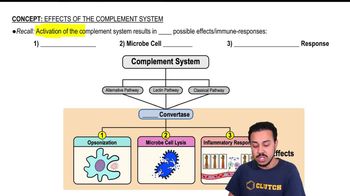
What are the three main effects of complement system activation?
카드를 뒤집기 위해 탭할 수 있습니다.
👆
What are the three main effects of complement system activation?
The three main effects are opsonization, microbe cell lysis, and the inflammatory response.
진행 상황 추적
컨트롤 버튼이 '내비게이션' 모드로 변경되었습니다.
1/15
관련 플래시카드
관련 실천
추천 영상
Effects of the Complement System definitions
Effects of the Complement System
15 용어
Effects of the Complement System
19. Innate Immunity
3 문제점
주제
Brendan
Review of the Complement System
19. Innate Immunity
3 문제점
주제
Brendan
19. Innate Immunity - Part 1 of 3
9 주제
12 문제점
장
Brendan
19. Innate Immunity - Part 2 of 3
10 주제
11 문제점
장
Nicole
19. Innate Immunity - Part 3 of 3
5 주제
11 문제점
장
Nicole
04:09
1) Opsonization
1521
views
16
rank
03:18
2) Cell Lysis of Invading Microbes
1337
views
11
rank
01:32
Effects of the Complement System
1332
views
16
rank
이 집합의 용어 (15)
하이드의 정의
What are the three main effects of complement system activation?
The three main effects are opsonization, microbe cell lysis, and the inflammatory response.
What enzyme is formed by all three complement activation pathways?
All three pathways lead to the formation of C3 convertase.
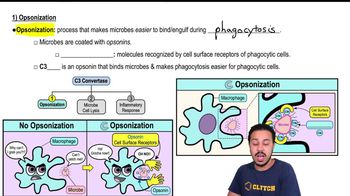
What is opsonization in the context of the complement system?
Opsonization is the process of coating microbes with opsonins to make them easier for phagocytes to bind and engulf.
Which complement protein acts as an opsonin during opsonization?
C3b acts as an opsonin by binding to the surface of microbes.
How does opsonization affect phagocytosis?
Opsonization makes phagocytosis easier and more efficient for phagocytic cells.
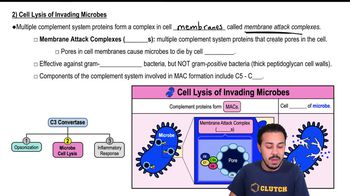
What is a membrane attack complex (MAC)?
A MAC is a structure formed by complement proteins that creates pores in microbe membranes, leading to cell lysis.
Which complement proteins are involved in forming the membrane attack complex?
Complement proteins C5 through C9 are involved in forming the MAC.
Why are membrane attack complexes more effective against gram-negative bacteria?
MACs are more effective against gram-negative bacteria because they target the outer lipid membrane, which is absent in gram-positive bacteria.
What happens to microbes when a membrane attack complex forms in their membrane?
The formation of a MAC causes pores in the membrane, leading to cell lysis and death of the microbe.
What triggers the inflammatory response in the complement system?
The inflammatory response is triggered by complement proteins C3a and C5a.
What changes do C3a and C5a induce in blood vessel epithelial cells?
C3a and C5a cause dilation of blood vessel epithelial cells, allowing immune cells to access the infection site.
What effect do C3a and C5a have on mast cells?
C3a and C5a cause mast cells to degranulate, releasing histamine and cytokines that promote inflammation.
What are the characteristic signs of inflammation?
Inflammation is characterized by swelling, redness, heat, pain, and sometimes loss of function.
How does the inflammatory response help eliminate microbes?
It promotes blood vessel dilation and immune cell migration to the infection site, aiding in microbe elimination.
What is the role of histamine and cytokines released during the inflammatory response?
Histamine and cytokines promote inflammation, which helps contain and eliminate microbes and restore tissue damage.
 뒤로뒤로
뒤로뒤로
 04:09
04:09