Skip to main content
Microbiology
나의 코스
배우기
시험 준비
AI 튜터
학습 가이드
교과서적 해결책
플래시카드
탐험해 보세요
앱을 사용해 보세요
나의 코스
배우기
시험 준비
AI 튜터
학습 가이드
교과서적 해결책
플래시카드
탐험해 보세요
앱을 사용해 보세요
뒤로
Electron Transport Chain quiz
카드를 뒤집기 위해 탭할 수 있습니다.
Where is the electron transport chain (ETC) located in eukaryotic cells?
카드를 뒤집기 위해 탭할 수 있습니다.
👆
Where is the electron transport chain (ETC) located in eukaryotic cells?
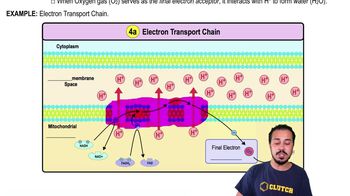
The ETC is located in the inner mitochondrial membrane of eukaryotic cells.
진행 상황 추적
컨트롤 버튼이 '내비게이션' 모드로 변경되었습니다.
1/15
관련 플래시카드
관련 실천
추천 영상
Electron Transport Chain definitions
Electron Transport Chain
15 용어
Electron Transport Chain
12. Microbial Metabolism
4 문제점
주제
Nicole
Chemiosmosis
12. Microbial Metabolism
3 문제점
주제
Nicole
12. Microbial Metabolism - Part 1 of 3
9 주제
14 문제점
장
Nicole
12. Microbial Metabolism - Part 2 of 3
6 주제
13 문제점
장
Nicole
12. Microbial Metabolism - Part 3 of 3
8 주제
13 문제점
장
Monica
04:43
Remembering the ETC
16496
views
203
rank
02:49
Electron Transport Chain in Prokaryotes
2541
views
24
rank
07:41
Electron Transport Chain
23320
views
333
rank
이 집합의 용어 (15)
하이드의 정의
Where is the electron transport chain (ETC) located in eukaryotic cells?
The ETC is located in the inner mitochondrial membrane of eukaryotic cells.
What is the main function of the electron transport chain in cellular respiration?
The ETC harnesses energy from electrons to create a hydrogen ion gradient across the inner mitochondrial membrane.
Which molecules donate electrons to the electron transport chain?
NADH and FADH2 donate electrons to the electron transport chain.
What is the final electron acceptor in the electron transport chain during aerobic respiration?
Oxygen (O2) is the final electron acceptor in the ETC during aerobic respiration.
What byproduct is formed when oxygen accepts electrons at the end of the ETC?
Water (H2O) is formed as a byproduct when oxygen accepts electrons and reacts with hydrogen ions.
What is the purpose of pumping hydrogen ions into the intermembrane space during the ETC?
Pumping hydrogen ions creates a concentration gradient that stores potential energy for ATP synthesis.
In the airport analogy, what do NADH and FADH2 represent?
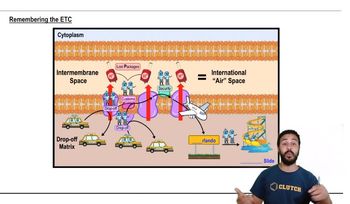
NADH and FADH2 are compared to taxis carrying electron 'passengers' to the ETC.
Where do electrons from NADH enter the electron transport chain compared to FADH2?
Electrons from NADH enter the ETC at an earlier point than those from FADH2.
What does the intermembrane space represent in the airport analogy?
The intermembrane space is likened to 'international airspace' in the airport analogy.
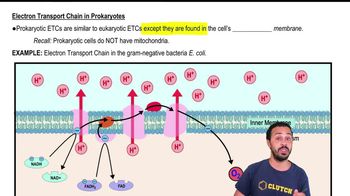
How is the ETC in prokaryotes different from that in eukaryotes?
In prokaryotes, the ETC is located in the plasma membrane, not the inner mitochondrial membrane.
Why don't prokaryotes have their ETC in mitochondria?
Prokaryotes lack mitochondria and other membrane-bound organelles, so their ETC is in the plasma membrane.
What is the main similarity between prokaryotic and eukaryotic ETCs?
Both use electron carriers to create a hydrogen ion gradient for ATP production.
What happens to NADH and FADH2 after they drop off their electrons at the ETC?
NADH becomes NAD+ and FADH2 becomes FAD after donating their electrons.
What type of reactions occur as electrons move through the ETC?
A series of redox (oxidation-reduction) reactions occur as electrons move through the ETC.
What is the significance of the hydrogen ion gradient created by the ETC?
The hydrogen ion gradient is essential for ATP synthesis during chemiosmosis, which follows the ETC.
 뒤로뒤로
뒤로뒤로
 04:43
04:43