Skip to main content
Microbiology
나의 코스
배우기
시험 준비
AI 튜터
학습 가이드
교과서적 해결책
플래시카드
탐험해 보세요
앱을 사용해 보세요
나의 코스
배우기
시험 준비
AI 튜터
학습 가이드
교과서적 해결책
플래시카드
탐험해 보세요
앱을 사용해 보세요
뒤로
Group Translocation quiz
카드를 뒤집기 위해 탭할 수 있습니다.
What is group translocation in bacteria?
카드를 뒤집기 위해 탭할 수 있습니다.
👆
What is group translocation in bacteria?
Group translocation is a transport process where a molecule is chemically modified as it crosses the membrane into the cell.
진행 상황 추적
컨트롤 버튼이 '내비게이션' 모드로 변경되었습니다.
1/15
관련 플래시카드
관련 실천
추천 영상
Group Translocation definitions
Group Translocation
13 용어
Group Translocation
6. Cell Membrane & Transport
3 문제점
주제
Brendan
Types of Small Molecule Transport Review
6. Cell Membrane & Transport
3 문제점
주제
Brendan
6. Cell Membrane & Transport - Part 1 of 2
7 주제
12 문제점
장
Monica
6. Cell Membrane & Transport - Part 2 of 2
8 주제
13 문제점
장
Brendan
03:37
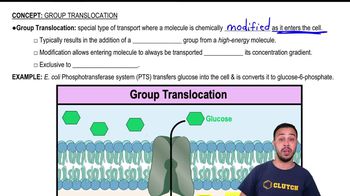
Group Translocation
2181
views
26
rank
이 집합의 용어 (15)
하이드의 정의
What is group translocation in bacteria?
Group translocation is a transport process where a molecule is chemically modified as it crosses the membrane into the cell.
What typically happens to a molecule during group translocation?
The molecule is usually modified by the addition of a phosphate group from a high-energy molecule.
Which organism group is group translocation exclusive to?
Group translocation is exclusive to bacteria.
What is the main energy source used in group translocation?
A high-energy molecule provides the phosphate group needed for the chemical modification.
How does group translocation allow continuous uptake of a molecule like glucose?
By modifying glucose to glucose-6-phosphate, the cell maintains a higher external glucose concentration, allowing continuous uptake.
What is the specific example of group translocation in E. coli called?
It is called the phosphotransferase system (PTS).
What happens to glucose as it enters an E. coli cell via group translocation?
Glucose is converted into glucose-6-phosphate as it is transported into the cell.
Why do glucose and glucose-6-phosphate have different concentration gradients?
Because they are chemically different, each has its own gradient across the membrane.
Why is group translocation sometimes considered a type of active transport?
Because it requires energy from a high-energy molecule to chemically modify the transported molecule.
What is the main benefit of chemically modifying a molecule during transport?
It allows the cell to keep importing the original molecule down its concentration gradient.
Where is the phosphate group added on glucose during group translocation?
The phosphate group is added to the 6th carbon of glucose, forming glucose-6-phosphate.
What role does the transporter protein play in group translocation?
The transporter protein facilitates the movement and chemical modification of the molecule as it enters the cell.
How does group translocation differ from simple diffusion?
In group translocation, the molecule is chemically modified and energy is used, unlike simple diffusion.
What is the fate of the high-energy molecule used in group translocation?
It donates a phosphate group to the incoming molecule, becoming dephosphorylated.
Why can the cell continuously import glucose using group translocation?
Because glucose is converted to glucose-6-phosphate inside the cell, the internal glucose concentration remains low, maintaining the gradient.
 뒤로뒤로
뒤로뒤로
 03:37
03:37