Skip to main content
Microbiology
나의 코스
배우기
시험 준비
AI 튜터
학습 가이드
교과서적 해결책
플래시카드
탐험해 보세요
앱을 사용해 보세요
나의 코스
배우기
시험 준비
AI 튜터
학습 가이드
교과서적 해결책
플래시카드
탐험해 보세요
앱을 사용해 보세요
뒤로
History of Spontaneous Generation Summarized quiz
카드를 뒤집기 위해 탭할 수 있습니다.
Who was the first scientist to challenge spontaneous generation in the 1600s?
카드를 뒤집기 위해 탭할 수 있습니다.
👆
Who was the first scientist to challenge spontaneous generation in the 1600s?
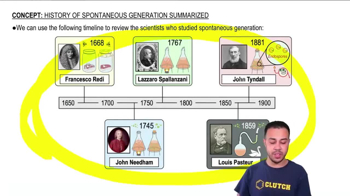
Francesco Redi was the first scientist to challenge spontaneous generation by showing that maggots come from fly eggs, not decaying meat.
진행 상황 추적
컨트롤 버튼이 '내비게이션' 모드로 변경되었습니다.
1/15
관련 플래시카드
관련 실천
추천 영상
History of Spontaneous Generation Summarized definitions
History of Spontaneous Generation Summarized
15 용어
History of Spontaneous Generation Summarized
2. Disproving Spontaneous Generation
3 문제점
주제
Nicole
John Tyndall's Experiment
2. Disproving Spontaneous Generation
3 문제점
주제
Nicole
2. Disproving Spontaneous Generation
6 주제
11 문제점
장
Brendan
03:56
History of Spontaneous Generation Summarized
2911
views
47
rank
이 집합의 용어 (15)
하이드의 정의
Who was the first scientist to challenge spontaneous generation in the 1600s?
Francesco Redi was the first scientist to challenge spontaneous generation by showing that maggots come from fly eggs, not decaying meat.
What did Francesco Redi's experiments demonstrate about maggots on decaying meat?
Redi's experiments showed that maggots originate from fly eggs laid on meat, not from spontaneous generation.
Which scientist attempted to prove spontaneous generation in the 1700s?
John Needham attempted to prove spontaneous generation through flawed experiments in the 1700s.
What was the main flaw in John Needham's experiments?
Needham's experiments were flawed because his methods allowed contamination, leading to false conclusions about spontaneous generation.
Who corrected Needham's experiments and what changes did he make?
Lazzaro Spallanzani corrected Needham's experiments by sealing the flasks and using longer boiling times.
What did Spallanzani's experiments show about microbial growth?
Spallanzani's experiments demonstrated that microbial growth does not spontaneously generate when air and contaminants are excluded.
Why did some scientists still believe in spontaneous generation after Spallanzani's experiments?
Some scientists believed Spallanzani's sealed flasks prevented a vital source from the air needed for spontaneous generation.
How did Louis Pasteur address the criticism of Spallanzani's experiments?
Pasteur used a swan neck flask that allowed air in but trapped dust and microbes, disproving spontaneous generation.
What was the outcome of Pasteur's swan neck flask experiment?
Pasteur observed no microbial growth in the swan neck flask, supporting biogenesis and disproving spontaneous generation.
Why did some scientists find microbial growth in Pasteur's replicated experiments?
Some scientists found microbial growth due to the presence of heat-resistant microbes, such as endospores.
Who explained the presence of heat-resistant microbes in broth experiments?
John Tyndall explained that heat-resistant microbes, like endospores, could survive boiling and cause microbial growth.
What did John Tyndall's findings support?
Tyndall's findings supported Pasteur's results and further disproved spontaneous generation.
What concept was ultimately proven by these experiments?
The experiments ultimately proved biogenesis, the idea that life comes from existing life, not spontaneous generation.
What is spontaneous generation?
Spontaneous generation is the belief that life can arise from non-living matter without any biological origin.
What is biogenesis?
Biogenesis is the principle that living organisms arise only from other living organisms.
 뒤로뒤로
뒤로뒤로
 03:56
03:56