Skip to main content
Microbiology
나의 코스
배우기
시험 준비
AI 튜터
학습 가이드
교과서적 해결책
플래시카드
탐험해 보세요
앱을 사용해 보세요
나의 코스
배우기
시험 준비
AI 튜터
학습 가이드
교과서적 해결책
플래시카드
탐험해 보세요
앱을 사용해 보세요
뒤로
Horizontal Gene Transfer quiz
카드를 뒤집기 위해 탭할 수 있습니다.
What is horizontal gene transfer?
카드를 뒤집기 위해 탭할 수 있습니다.
👆
What is horizontal gene transfer?
Horizontal gene transfer is the exchange of genes between two organisms that are not direct descendants, allowing rapid acquisition of new traits.
진행 상황 추적
컨트롤 버튼이 '내비게이션' 모드로 변경되었습니다.
1/15
관련 플래시카드
관련 실천
추천 영상
Horizontal Gene Transfer definitions
Horizontal Gene Transfer
14 용어
Horizontal Gene Transfer
16. Microbial Genetics
5 문제점
주제
Brendan
Bacterial Transformation
16. Microbial Genetics
5 문제점
주제
Nicole
16. Microbial Genetics - Part 1 of 2
9 주제
14 문제점
장
Monica
16. Microbial Genetics - Part 2 of 2
8 주제
13 문제점
장
Nicole
03:13
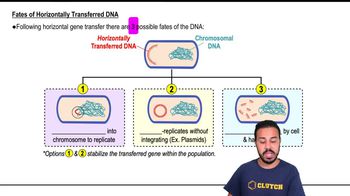
Fates of Horizontally Transferred DNA
1669
views
22
rank
04:42
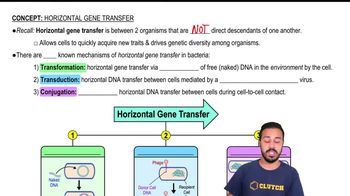
Horizontal Gene Transfer
2469
views
27
rank
02:52
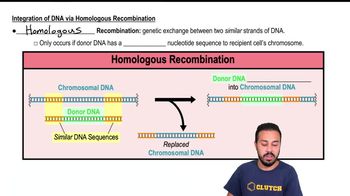
Integration of DNA via Homologous Recombination
1736
views
13
rank
이 집합의 용어 (15)
하이드의 정의
What is horizontal gene transfer?
Horizontal gene transfer is the exchange of genes between two organisms that are not direct descendants, allowing rapid acquisition of new traits.
Name the three primary mechanisms of horizontal gene transfer in bacteria.
The three mechanisms are transformation, transduction, and conjugation.
What is transformation in the context of horizontal gene transfer?
Transformation is the uptake of free or naked DNA from the environment by a bacterial cell.
How does transduction differ from transformation?
Transduction is mediated by bacteriophages (viruses that infect bacteria), while transformation involves direct uptake of free DNA.
What role do bacteriophages play in horizontal gene transfer?
Bacteriophages transfer DNA from one bacterial cell to another during the process of transduction.
Describe conjugation as a mechanism of horizontal gene transfer.
Conjugation involves direct cell-to-cell contact, allowing DNA to be transferred from one bacterium to another.
What are the three possible fates of horizontally transferred DNA in a bacterial cell?
The DNA can integrate into the chromosome, remain as a self-replicating entity like a plasmid, or be degraded.
What happens if horizontally transferred DNA integrates into the chromosome?
It becomes part of the chromosomal DNA and replicates alongside it, potentially passing new traits to future generations.
What is a plasmid in the context of horizontal gene transfer?
A plasmid is a small, circular, self-replicating DNA molecule that can exist independently of the chromosomal DNA.
What is the fate of horizontally transferred DNA if it is degraded?
If degraded, the DNA is broken into pieces and has no effect on the cell.
Which two fates of horizontally transferred DNA can stabilize new genes in a bacterial population?
Integration into the chromosome and maintenance as a self-replicating plasmid can stabilize new genes.
What is homologous recombination?
Homologous recombination is the genetic exchange between two similar DNA strands, allowing donor DNA to integrate into the recipient's chromosome.
What is required for homologous recombination to occur?
The donor DNA must have a similar nucleotide sequence to the recipient cell's chromosomal DNA.
How does homologous recombination affect the recipient cell's DNA?
It allows donor DNA to replace a region of the recipient's chromosomal DNA, integrating new genetic material.
Why is horizontal gene transfer important for bacteria?
It increases genetic diversity and enables bacteria to quickly acquire new traits, such as antibiotic resistance.
 뒤로뒤로
뒤로뒤로
 03:13
03:13