Skip to main content
Microbiology
나의 코스
배우기
시험 준비
AI 튜터
학습 가이드
교과서적 해결책
플래시카드
탐험해 보세요
앱을 사용해 보세요
나의 코스
배우기
시험 준비
AI 튜터
학습 가이드
교과서적 해결책
플래시카드
탐험해 보세요
앱을 사용해 보세요
뒤로
Hydrogen Bonding definitions
카드를 뒤집기 위해 탭할 수 있습니다.
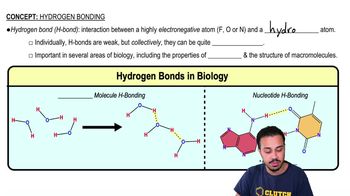
Hydrogen Bond
카드를 뒤집기 위해 탭할 수 있습니다.
👆
Hydrogen Bond
An interaction involving a hydrogen atom and a highly electronegative atom, crucial for many biological structures and properties.
진행 상황 추적
컨트롤 버튼이 '내비게이션' 모드로 변경되었습니다.
1/13
관련 플래시카드
관련 실천
추천 영상
Hydrogen Bonding quiz
Hydrogen Bonding
15 용어
Hydrogen Bonding
3. Chemical Principles of Microbiology
3 문제점
주제
Brendan
Ionic Bonding
3. Chemical Principles of Microbiology
3 문제점
주제
Nicole
3. Chemical Principles of Microbiology
7 주제
12 문제점
장
Nicole
05:03
Hydrogen Bonding
22878
views
374
rank
이 집합의 용어 (13)
하이드의 정의
Hydrogen Bond
An interaction involving a hydrogen atom and a highly electronegative atom, crucial for many biological structures and properties.
Electronegativity
A property of certain atoms, like fluorine, oxygen, and nitrogen, that enables strong attraction to electrons in bonds.
Fluorine
A highly electronegative atom capable of forming strong interactions with hydrogen in biological molecules.
Oxygen
A key atom in water and macromolecules, known for its strong attraction to hydrogen in specific molecular interactions.
Nitrogen
An atom found in nucleotides and other molecules, often forming important interactions with hydrogen atoms.
Water Molecule
A compound consisting of two hydrogens and one oxygen, whose unique properties arise from specific atomic interactions.
Macromolecule
A large biological molecule whose structure and function often depend on collective weak interactions.
Nucleotide
A building block of genetic material, capable of forming specific interactions essential for DNA structure.
DNA
A genetic material whose double-helix structure is stabilized by multiple weak interactions between its components.
FON
A mnemonic for the three atoms—fluorine, oxygen, nitrogen—that commonly participate in specific weak interactions.
Biological Process
A series of events in living organisms that often rely on collective weak interactions for proper function.
Interaction
A non-covalent association between atoms or molecules, often contributing to the stability of biological systems.
Bond Strength
A measure of how easily an association between atoms can be disrupted, varying from weak individually to strong collectively.
 뒤로뒤로
뒤로뒤로
 05:03
05:03