Skip to main content
Microbiology
나의 코스
배우기
시험 준비
AI 튜터
학습 가이드
교과서적 해결책
플래시카드
탐험해 보세요
앱을 사용해 보세요
나의 코스
배우기
시험 준비
AI 튜터
학습 가이드
교과서적 해결책
플래시카드
탐험해 보세요
앱을 사용해 보세요
뒤로
Interferon Response quiz
카드를 뒤집기 위해 탭할 수 있습니다.
What are interferons (IFNs) and what is their main function?
카드를 뒤집기 위해 탭할 수 있습니다.
👆
What are interferons (IFNs) and what is their main function?
Interferons are cytokines that provide antiviral effects by warning neighboring cells of viral infection and initiating their antiviral defenses.
진행 상황 추적
컨트롤 버튼이 '내비게이션' 모드로 변경되었습니다.
1/15
관련 플래시카드
관련 실천
추천 영상
Interferon Response definitions
Interferon Response
15 용어
Interferon Response
19. Innate Immunity
5 문제점
주제
Brendan
Fever
19. Innate Immunity
4 문제점
주제
Nicole
19. Innate Immunity - Part 1 of 3
9 주제
12 문제점
장
Brendan
19. Innate Immunity - Part 2 of 3
10 주제
11 문제점
장
Nicole
19. Innate Immunity - Part 3 of 3
5 주제
11 문제점
장
Nicole
01:32
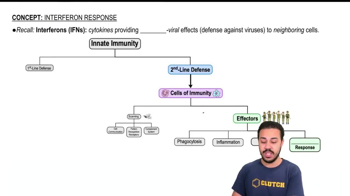
Interferon Response
1442
views
12
rank
09:59
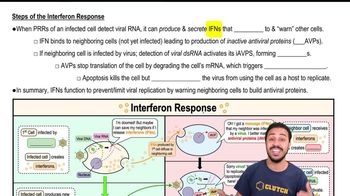
Steps of the Interferon Response
1306
views
7
rank
이 집합의 용어 (15)
하이드의 정의
What are interferons (IFNs) and what is their main function?
Interferons are cytokines that provide antiviral effects by warning neighboring cells of viral infection and initiating their antiviral defenses.
How do infected cells detect the presence of a virus?
Infected cells detect viral RNA through pattern recognition receptors (PRRs).
What do infected cells do after detecting viral RNA?
They produce and secrete interferons, which then diffuse to neighboring cells.
How do interferons affect neighboring cells?
Interferons bind to neighboring cells and warn them of the viral presence, prompting them to prepare antiviral defenses.
What do neighboring cells produce in response to interferon binding?
They produce inactive antiviral proteins (IAVPs), which are ready to be activated if the cell becomes infected.
When do inactive antiviral proteins (IAVPs) become activated?
IAVPs are activated when the neighboring cell detects viral RNA, indicating infection.
What is the function of active antiviral proteins (AVPs)?
AVPs degrade the cell's mRNA and trigger apoptosis, preventing the virus from replicating.
Why does the initially infected cell release interferons even though it will die?
The infected cell releases interferons to warn neighboring cells and help control the spread of the virus.
What is apoptosis and how does it help in the interferon response?
Apoptosis is programmed cell death, which prevents the virus from using the cell to replicate.
How does the interferon response limit viral replication?
It prompts neighboring cells to prepare antiviral defenses, so if they are infected, they can quickly undergo apoptosis and stop viral replication.
What is the overall benefit of the interferon response for the body?
It helps limit the spread of the virus and buys time for the immune system to eliminate the infection.
What happens to the first cell that is infected by the virus?
The first infected cell usually dies and produces new viruses, but it helps protect neighboring cells by releasing interferons.
What is the abbreviation for interferons and inactive antiviral proteins?
Interferons are abbreviated as IFNs, and inactive antiviral proteins as IAVPs.
What triggers the production of IAVPs in neighboring cells?
The binding of interferons to neighboring cells triggers the production of IAVPs.
How does the interferon response contribute to innate immunity?
It acts as a second line of defense by providing antiviral effects and limiting viral replication before the adaptive immune system responds.
 뒤로
뒤로
 01:32
01:32