Skip to main content
Microbiology
나의 코스
배우기
시험 준비
AI 튜터
학습 가이드
교과서적 해결책
플래시카드
탐험해 보세요
앱을 사용해 보세요
나의 코스
배우기
시험 준비
AI 튜터
학습 가이드
교과서적 해결책
플래시카드
탐험해 보세요
앱을 사용해 보세요
뒤로
Introduction to B Lymphocytes quiz
카드를 뒤집기 위해 탭할 수 있습니다.
What is the primary role of B lymphocytes (B cells) in the immune system?
카드를 뒤집기 위해 탭할 수 있습니다.
👆
What is the primary role of B lymphocytes (B cells) in the immune system?
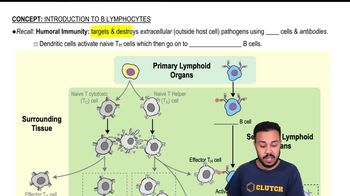
B cells are crucial for adaptive humoral immunity, targeting and destroying extracellular pathogens using antibodies.
진행 상황 추적
컨트롤 버튼이 '내비게이션' 모드로 변경되었습니다.
1/15
관련 플래시카드
관련 실천
추천 영상
Introduction to B Lymphocytes definitions
Introduction to B Lymphocytes
15 용어
Introduction to B Lymphocytes
20. Adaptive Immunity
3 문제점
주제
Nicole
Antibodies
20. Adaptive Immunity
6 문제점
주제
Brendan
20. Adaptive Immunity - Part 1 of 3
7 주제
12 문제점
장
Brendan
20. Adaptive Immunity - Part 2 of 3
6 주제
13 문제점
장
Brendan
20. Adaptive Immunity - Part 3 of 3
7 주제
13 문제점
장
Brendan
04:37
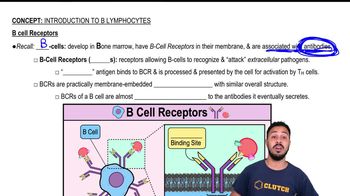
B cell Receptors
1167
views
15
rank
04:23
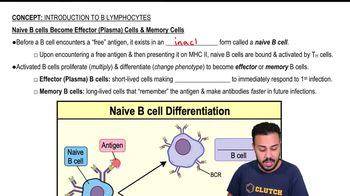
Naive B cells Become Effector (Plasma) Cells & Memory Cells
1365
views
10
rank
03:55
Introduction to B Lymphocytes
1290
views
11
rank
이 집합의 용어 (15)
하이드의 정의
What is the primary role of B lymphocytes (B cells) in the immune system?
B cells are crucial for adaptive humoral immunity, targeting and destroying extracellular pathogens using antibodies.
Where do B cells fully develop in the body?
B cells fully develop in the bone marrow, which is a primary lymphoid organ.
What is the difference between B cell receptors (BCRs) and T cell receptors (TCRs) in antigen recognition?
BCRs can bind to free-floating antigens, while TCRs can only bind to antigens presented on MHC molecules.
What happens to a naive B cell when it encounters its specific antigen?
The naive B cell internalizes, processes, and presents the antigen on MHC class II molecules for activation by helper T cells.
How are B cells activated after antigen presentation?
Helper T cells recognize the antigen on MHC class II molecules and release cytokines that activate the B cell.
Into what two main cell types can activated B cells differentiate?
Activated B cells can differentiate into memory B cells or plasma cells.
What is the function of plasma cells derived from B cells?
Plasma cells are short-lived effector cells that secrete large amounts of antibodies to combat infections immediately.
What is the role of memory B cells?
Memory B cells are long-lived cells that respond quickly to future infections by the same antigen.
How many antigen-binding sites does a typical B cell receptor (BCR) have?
A typical BCR has two antigen-binding sites.
What is the structural relationship between BCRs and antibodies?
BCRs are membrane-embedded antibodies, and their structure closely resembles the antibodies that plasma cells produce.
What is a naive B cell?
A naive B cell is an inactive B cell that has not yet encountered its specific antigen.
What is the main function of antibodies produced by plasma cells?
Antibodies bind to and help neutralize or eliminate extracellular pathogens.
What is the significance of BCRs being 'membrane-embedded antibodies'?
This means BCRs have a structure similar to secreted antibodies and can bind antigens directly on the B cell surface.
What triggers the proliferation and differentiation of B cells?
Activation by helper T cells after antigen presentation triggers B cells to proliferate and differentiate.
How do memory B cells contribute to immunity upon re-infection?
Memory B cells enable a faster and more effective immune response during subsequent exposures to the same antigen.
 뒤로뒤로
뒤로뒤로
 04:37
04:37