Skip to main content
Microbiology
나의 코스
배우기
시험 준비
AI 튜터
학습 가이드
교과서적 해결책
플래시카드
탐험해 보세요
앱을 사용해 보세요
나의 코스
배우기
시험 준비
AI 튜터
학습 가이드
교과서적 해결책
플래시카드
탐험해 보세요
앱을 사용해 보세요
뒤로
Introduction to Energy definitions
카드를 뒤집기 위해 탭할 수 있습니다.
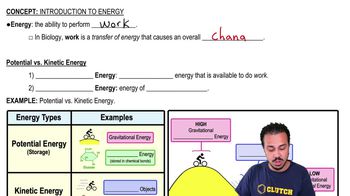
Energy
카드를 뒤집기 위해 탭할 수 있습니다.
👆
Energy
Ability to cause an overall change in a living system, enabling biological processes and transformations.
진행 상황 추적
컨트롤 버튼이 '내비게이션' 모드로 변경되었습니다.
1/15
관련 플래시카드
관련 실천
추천 영상
Introduction to Energy quiz
Introduction to Energy
15 용어
Introduction to Energy
12. Microbial Metabolism
3 문제점
주제
Nicole
Laws of Thermodynamics
12. Microbial Metabolism
3 문제점
주제
Nicole
12. Microbial Metabolism - Part 1 of 3
9 주제
14 문제점
장
Nicole
12. Microbial Metabolism - Part 2 of 3
6 주제
13 문제점
장
Nicole
12. Microbial Metabolism - Part 3 of 3
8 주제
13 문제점
장
Monica
04:21
Thermodynamics: System vs. Surroundings
21620
views
344
rank
04:58
Introduction to Energy
29090
views
580
rank
이 집합의 용어 (15)
하이드의 정의
Energy
Ability to cause an overall change in a living system, enabling biological processes and transformations.
Work
Transfer of energy resulting in an overall change within a biological context, not related to academic assignments.
Potential Energy
Stored form capable of being used to cause change, such as energy held by position or chemical bonds.
Kinetic Energy
Form associated with motion, present in moving objects or during muscle contractions.
Gravitational Potential Energy
Stored form due to an object's position relative to gravity, such as a biker at the top of a hill.
Chemical Potential Energy
Stored form within chemical bonds, exemplified by molecules like glucose in biological systems.
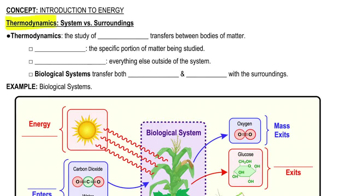
Thermodynamics
Study of energy transfers between bodies of matter, focusing on how energy moves and changes form.
System
Specific portion of matter under study, which can range from a single reaction to an entire organism.
Surroundings
Everything external to the system, encompassing all matter and energy outside the area of focus.
Biological System
Living entity capable of exchanging both energy and mass with its environment, such as a plant.
Photosynthesis
Process where solar energy, carbon dioxide, and water are converted into glucose and oxygen in plants.
Glucose
Most abundant sugar, serving as a primary example of stored chemical potential energy in cells.
Oxygen
Gaseous product released from biological systems during processes like photosynthesis.
Carbon Dioxide
Gaseous molecule entering biological systems, used as a raw material in energy conversion processes.
Solar Energy
Form of energy from sunlight, utilized by plants to drive the conversion of inorganic molecules into organic compounds.
 뒤로뒤로
뒤로뒤로
 04:21
04:21