Skip to main content
Microbiology
나의 코스
배우기
시험 준비
AI 튜터
학습 가이드
교과서적 해결책
플래시카드
탐험해 보세요
앱을 사용해 보세요
나의 코스
배우기
시험 준비
AI 튜터
학습 가이드
교과서적 해결책
플래시카드
탐험해 보세요
앱을 사용해 보세요
뒤로
Introduction to Inflammation definitions
카드를 뒤집기 위해 탭할 수 있습니다.
Inflammation
카드를 뒤집기 위해 탭할 수 있습니다.
👆
Inflammation
A coordinated set of events triggered by infection or tissue damage, marked by distinct physical changes and immune cell activity.
진행 상황 추적
컨트롤 버튼이 '내비게이션' 모드로 변경되었습니다.
1/14
관련 플래시카드
관련 실천
추천 영상
Introduction to Inflammation quiz #1
Introduction to Inflammation
10 용어
Introduction to Inflammation
19. Innate Immunity
4 문제점
주제
Brendan
Steps of the Inflammatory Response
19. Innate Immunity
4 문제점
주제
Nicole
19. Innate Immunity - Part 1 of 3
9 주제
12 문제점
장
Brendan
19. Innate Immunity - Part 2 of 3
10 주제
11 문제점
장
Nicole
19. Innate Immunity - Part 3 of 3
5 주제
11 문제점
장
Nicole
02:52
Types of Inflammatory Responses
1388
views
12
rank
01:38
Introduction to Inflammation
1492
views
13
rank
03:09
Chronic Inflammation
1232
views
9
rank
이 집합의 용어 (14)
하이드의 정의
Inflammation
A coordinated set of events triggered by infection or tissue damage, marked by distinct physical changes and immune cell activity.
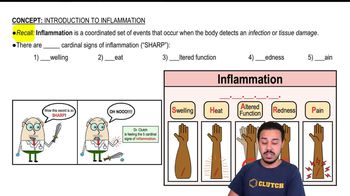
SHARP
An acronym summarizing the five cardinal signs: swelling, heat, altered function, redness, and pain.
Swelling
A cardinal sign resulting from fluid accumulation at the site of tissue injury or infection.
Heat
A cardinal sign caused by increased blood flow to affected tissues during the inflammatory response.
Altered Function
A cardinal sign where normal activity of the affected area is impaired due to inflammation.
Redness
A cardinal sign resulting from dilation of blood vessels and increased blood flow to the inflamed area.
Pain
A cardinal sign arising from chemical mediators and pressure on nerve endings at the site of inflammation.
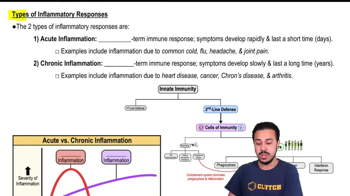
Acute Inflammation
A short-term immune response with rapid symptom onset, primarily involving neutrophils, resolving in days.
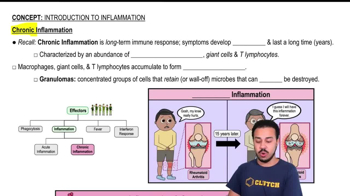
Chronic Inflammation
A long-term immune response with slow symptom development, involving macrophages, giant cells, and T lymphocytes.
Neutrophils
Immune cells rapidly recruited to sites of acute inflammation, acting as the first responders to infection or injury.
Macrophages
Immune cells abundant in chronic inflammation, responsible for engulfing pathogens and cellular debris.
Giant Cells
Large cells formed by the fusion of macrophages, commonly found in chronic inflammatory sites.
T Lymphocytes
Adaptive immune cells present in chronic inflammation, contributing to the formation of granulomas.
Granuloma
A structured cluster of immune cells that walls off microbes resistant to elimination during chronic inflammation.
 뒤로뒤로
뒤로뒤로
 02:52
02:52