Skip to main content
Microbiology
나의 코스
배우기
시험 준비
AI 튜터
학습 가이드
교과서적 해결책
플래시카드
탐험해 보세요
앱을 사용해 보세요
나의 코스
배우기
시험 준비
AI 튜터
학습 가이드
교과서적 해결책
플래시카드
탐험해 보세요
앱을 사용해 보세요
뒤로
Introduction to Taxonomy definitions
카드를 뒤집기 위해 탭할 수 있습니다.
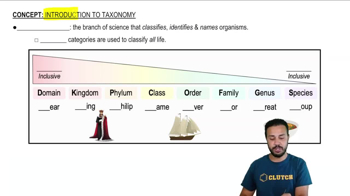
Taxonomy
카드를 뒤집기 위해 탭할 수 있습니다.
👆
Taxonomy
Branch of science focused on classifying, identifying, and naming living organisms using hierarchical categories.
진행 상황 추적
컨트롤 버튼이 '내비게이션' 모드로 변경되었습니다.
1/15
관련 플래시카드
관련 실천
추천 영상
Introduction to Taxonomy quiz #1
Introduction to Taxonomy
10 용어
Introduction to Taxonomy
1. Introduction to Microbiology
7 문제점
주제
Monica
Scientific Naming of Organisms
1. Introduction to Microbiology
4 문제점
주제
Monica
1. Introduction to Microbiology - Part 1 of 2
5 주제
14 문제점
장
Monica
1. Introduction to Microbiology - Part 2 of 2
6 주제
14 문제점
장
Brendan
01:37
Introduction to Taxonomy Example 2
15902
views
331
rank
06:14
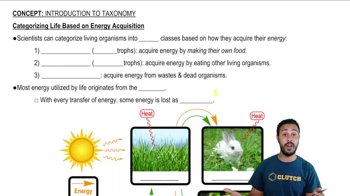
Categorizing Life Based on Energy Acquisition
17310
views
421
rank
02:23
Introduction to Taxonomy
28914
views
665
rank
이 집합의 용어 (15)
하이드의 정의
Taxonomy
Branch of science focused on classifying, identifying, and naming living organisms using hierarchical categories.
Domain
Most inclusive taxonomic category, grouping all living organisms into three broad types based on cell structure.
Kingdom
Major taxonomic rank below domain, further dividing organisms based on fundamental traits like cell type and nutrition.
Phylum
Taxonomic category below kingdom, grouping organisms with similar body plans or major structural features.
Class
Taxonomic rank below phylum, organizing organisms with shared characteristics within a phylum.
Order
Taxonomic level below class, grouping families with common attributes and evolutionary traits.
Family
Taxonomic category below order, clustering closely related genera based on structural similarities.
Genus
Taxonomic group below family, containing species that are structurally similar and closely related.
Species
Smallest taxonomic unit, representing a group of organisms capable of interbreeding and producing fertile offspring.
Prokaryotic Cell
Cell type lacking a nucleus and membrane-bound organelles, characteristic of bacteria and archaea.
Eukaryotic Cell
Cell type containing a nucleus and membrane-bound organelles, found in animals, plants, fungi, and protists.
Phylogenetic Tree
Diagram illustrating evolutionary relationships among organisms, often called the tree of life.
Producer
Organism capable of making its own food from inorganic sources, forming the base of energy flow in ecosystems.
Consumer
Organism that obtains energy by eating other living organisms, transferring energy up the food chain.
Decomposer
Organism that breaks down dead matter and wastes, recycling nutrients back into the ecosystem.
 뒤로뒤로
뒤로뒤로
 01:37
01:37