Skip to main content
Microbiology
나의 코스
배우기
시험 준비
AI 튜터
학습 가이드
교과서적 해결책
플래시카드
탐험해 보세요
앱을 사용해 보세요
나의 코스
배우기
시험 준비
AI 튜터
학습 가이드
교과서적 해결책
플래시카드
탐험해 보세요
앱을 사용해 보세요
뒤로
Leading & Lagging DNA Strands definitions
카드를 뒤집기 위해 탭할 수 있습니다.
Replication Fork
카드를 뒤집기 위해 탭할 수 있습니다.
👆
Replication Fork
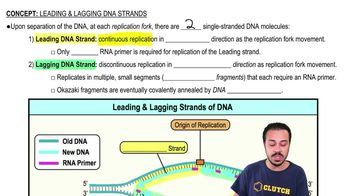
Y-shaped region where DNA strands separate and new synthesis occurs, creating leading and lagging strands.
진행 상황 추적
컨트롤 버튼이 '내비게이션' 모드로 변경되었습니다.
1/12
관련 플래시카드
관련 실천
추천 영상
Leading & Lagging DNA Strands quiz
Leading & Lagging DNA Strands
15 용어
Leading & Lagging DNA Strands
14. DNA Replication
3 문제점
주제
Brendan
Steps of DNA Replication
14. DNA Replication
4 문제점
주제
Brendan
14. DNA Replication
10 주제
14 문제점
장
Brendan
05:15
Leading & Lagging DNA Strands
17866
views
199
rank
이 집합의 용어 (12)
하이드의 정의
Replication Fork
Y-shaped region where DNA strands separate and new synthesis occurs, creating leading and lagging strands.
Leading Strand
DNA segment synthesized continuously in the same direction as the replication fork movement, needing only one RNA primer.
Lagging Strand
DNA segment synthesized discontinuously in the opposite direction of fork movement, forming short fragments.
Okazaki Fragments
Short DNA segments formed on the lagging strand, each requiring its own RNA primer before being joined together.
DNA Ligase
Enzyme responsible for covalently joining Okazaki fragments to create a continuous DNA strand on the lagging side.
RNA Primer
Short RNA sequence providing a starting point for DNA synthesis, required once for the leading strand and multiple times for the lagging strand.
Origin of Replication
Specific DNA sequence where the process of replication begins, forming replication bubbles and forks.
Continuous Replication
Mode of DNA synthesis where nucleotides are added in an unbroken chain, as seen on the leading strand.
Discontinuous Replication
Mode of DNA synthesis involving the creation of short DNA fragments, characteristic of the lagging strand.
DNA Polymerase
Enzyme that synthesizes new DNA strands in the 5' to 3' direction, dictating the need for Okazaki fragments.
Replication Bubble
Structure formed during DNA replication, containing two replication forks moving in opposite directions.
5' to 3' Direction
Orientation in which DNA polymerase adds nucleotides, influencing the synthesis pattern of both DNA strands.
 뒤로뒤로
뒤로뒤로
 05:15
05:15