Skip to main content
Microbiology
나의 코스
배우기
시험 준비
AI 튜터
학습 가이드
교과서적 해결책
플래시카드
탐험해 보세요
앱을 사용해 보세요
나의 코스
배우기
시험 준비
AI 튜터
학습 가이드
교과서적 해결책
플래시카드
탐험해 보세요
앱을 사용해 보세요
뒤로
Members of the Bacterial World definitions
카드를 뒤집기 위해 탭할 수 있습니다.
Microbial World
카드를 뒤집기 위해 탭할 수 있습니다.
👆
Microbial World
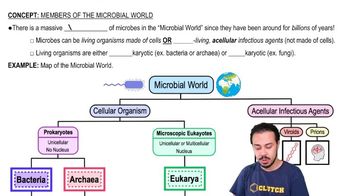
Encompasses all microscopic life forms, both living and nonliving, including cellular organisms and acellular infectious agents.
진행 상황 추적
컨트롤 버튼이 '내비게이션' 모드로 변경되었습니다.
1/15
관련 플래시카드
관련 실천
추천 영상
Members of the Bacterial World quiz #1
Members of the Bacterial World
34 용어
Members of the Bacterial World quiz #2
Members of the Bacterial World
36 용어
Members of the Bacterial World quiz #3
Members of the Bacterial World
39 용어
Members of the Bacterial World
1. Introduction to Microbiology
4 문제점
주제
Brendan
Introduction to Bacteria
1. Introduction to Microbiology
7 문제점
주제
Monica
1. Introduction to Microbiology - Part 1 of 2
5 주제
14 문제점
장
Monica
1. Introduction to Microbiology - Part 2 of 2
6 주제
14 문제점
장
Brendan
06:17
Members of the Bacterial World
7442
views
209
rank
이 집합의 용어 (15)
하이드의 정의
Microbial World
Encompasses all microscopic life forms, both living and nonliving, including cellular organisms and acellular infectious agents.
Prokaryote
A unicellular organism lacking a nucleus, with genetic material not enclosed within a membrane-bound compartment.
Eukaryote
An organism whose cells contain a nucleus, which can be unicellular or multicellular, and includes microscopic forms.
Bacteria
A domain of prokaryotic, unicellular organisms, distinct from archaea, with unique cellular structures.
Archaea
A domain of prokaryotic, unicellular organisms, fundamentally different from bacteria and eukaryotes.
Fungi
A group of eukaryotic organisms, often studied by microbiologists, that can be unicellular or multicellular.
Algae
Microscopic eukaryotic organisms, classified as protists, capable of photosynthesis and found in aquatic environments.
Protozoa
Microscopic, unicellular eukaryotic organisms, often motile, and classified as protists.
Helminths
Microscopic, multicellular eukaryotic organisms, commonly referred to as parasitic worms.
Virus
An acellular infectious agent, not made of cells, requiring a host to replicate and cause infection.
Viroid
A type of acellular infectious agent, consisting solely of a short strand of RNA, lacking a protein coat.
Prion
An acellular infectious agent composed entirely of misfolded protein, capable of causing neurodegenerative diseases.
Cellular Organism
A living entity composed of one or more cells, classified as either prokaryotic or eukaryotic.
Acellular Infectious Agent
A nonliving entity, not made of cells, capable of causing disease, including viruses, viroids, and prions.
Nucleus
A membrane-bound compartment within eukaryotic cells that houses genetic material.
 뒤로뒤로
뒤로뒤로
 06:17
06:17