Skip to main content
Microbiology
나의 코스
배우기
시험 준비
AI 튜터
학습 가이드
교과서적 해결책
플래시카드
탐험해 보세요
앱을 사용해 보세요
나의 코스
배우기
시험 준비
AI 튜터
학습 가이드
교과서적 해결책
플래시카드
탐험해 보세요
앱을 사용해 보세요
뒤로
Meselson-Stahl Experiment definitions
카드를 뒤집기 위해 탭할 수 있습니다.
Meselson-Stahl Experiment
카드를 뒤집기 위해 탭할 수 있습니다.
👆
Meselson-Stahl Experiment
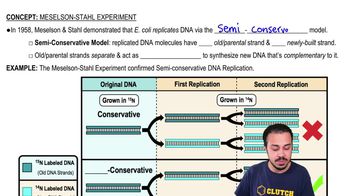
A landmark study using isotopic labeling to confirm the semi-conservative mechanism of DNA replication in E. coli.
진행 상황 추적
컨트롤 버튼이 '내비게이션' 모드로 변경되었습니다.
1/15
관련 플래시카드
관련 실천
추천 영상
Meselson-Stahl Experiment quiz
Meselson-Stahl Experiment
15 용어
Meselson-Stahl Experiment
14. DNA Replication
3 문제점
주제
Brendan
Introduction to DNA Replication
14. DNA Replication
3 문제점
주제
Brendan
14. DNA Replication
10 주제
14 문제점
장
Brendan
09:03
Meselson-Stahl Experiment
11824
views
126
rank
이 집합의 용어 (15)
하이드의 정의
Meselson-Stahl Experiment
A landmark study using isotopic labeling to confirm the semi-conservative mechanism of DNA replication in E. coli.
Semi-conservative Model
A replication process where each DNA molecule contains one parental strand and one newly synthesized strand.
Conservative Model
A disproven hypothesis suggesting the original DNA molecule remains intact while an entirely new copy is made.
Dispersive Model
A rejected theory proposing that parental DNA is interspersed in segments throughout both strands of daughter molecules.
DNA Replication
The cellular process ensuring genetic information is accurately copied for transmission to new cells.
E. coli
A bacterial species used as a model organism to study DNA replication mechanisms in the experiment.
Nitrogen-15
A heavy isotope used to label original DNA strands, allowing differentiation from newly synthesized DNA.
Nitrogen-14
A lighter isotope incorporated into new DNA strands, enabling tracking of replication events.
Parental Strand
An original DNA strand serving as a template for the synthesis of a complementary new strand.
Template
A DNA strand guiding the assembly of a complementary sequence during replication.
Isotopic Labeling
A technique using different atomic forms to distinguish between old and new DNA strands.
Generation
A single cycle of cell division, marking the passage of genetic material to progeny.
Strand Separation
The process where two DNA strands dissociate, allowing each to guide synthesis of a new partner.
Model Organism
A species extensively studied to understand biological processes, such as E. coli in DNA research.
Replication Mechanism
The specific sequence of molecular events by which DNA is duplicated within a cell.
 뒤로뒤로
뒤로뒤로
 09:03
09:03