Skip to main content
Microbiology
나의 코스
배우기
시험 준비
AI 튜터
학습 가이드
교과서적 해결책
플래시카드
탐험해 보세요
앱을 사용해 보세요
나의 코스
배우기
시험 준비
AI 튜터
학습 가이드
교과서적 해결책
플래시카드
탐험해 보세요
앱을 사용해 보세요
뒤로
Needham vs. Spallanzani quiz
카드를 뒤집기 위해 탭할 수 있습니다.
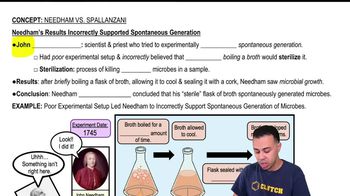
What was John Needham trying to prove with his experiments in the mid-1700s?
카드를 뒤집기 위해 탭할 수 있습니다.
👆
What was John Needham trying to prove with his experiments in the mid-1700s?
John Needham was trying to experimentally prove the concept of spontaneous generation, the idea that life could arise from non-living matter.
진행 상황 추적
컨트롤 버튼이 '내비게이션' 모드로 변경되었습니다.
1/15
관련 플래시카드
관련 실천
추천 영상
Needham vs. Spallanzani definitions
Needham vs. Spallanzani
15 용어
Needham vs. Spallanzani
2. Disproving Spontaneous Generation
3 문제점
주제
Nicole
Pasteur's Experiments on Spontaneous Generation
2. Disproving Spontaneous Generation
5 문제점
주제
Nicole
2. Disproving Spontaneous Generation
6 주제
11 문제점
장
Brendan
05:56
Needham vs. Spallanzani
4163
views
58
rank
05:34
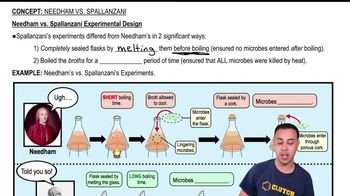
Needham vs. Spallanzani Experimental Design
2548
views
30
rank
07:22
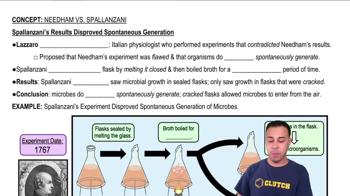
Spallanzani’s Results Disproved Spontaneous Generation
2949
views
42
rank
이 집합의 용어 (15)
하이드의 정의
What was John Needham trying to prove with his experiments in the mid-1700s?
John Needham was trying to experimentally prove the concept of spontaneous generation, the idea that life could arise from non-living matter.
Why did John Needham believe his broth was sterile after boiling?
He believed that briefly boiling the broth was enough to kill all microbes, not realizing that brief boiling does not always sterilize.
How did John Needham seal his flasks after boiling the broth?
He sealed his flasks with a cork, which is porous and could allow microbes to enter.
What was the main flaw in Needham's experimental setup?
The main flaw was that his brief boiling did not kill all microbes and his cork seal allowed for contamination from the air.
What did Needham conclude when he observed microbial growth in his flasks?
He incorrectly concluded that the microbes had spontaneously generated in the broth.
Who contradicted Needham's findings and when?
Lazaro Spallanzani contradicted Needham's findings in 1767.
How did Spallanzani seal his flasks differently from Needham?
Spallanzani sealed his flasks by melting the glass closed, which prevented microbial contamination.
What was the significance of Spallanzani boiling his broth for a longer period?
Longer boiling ensured that all microbes were killed, making the broth truly sterile.
What happened in Spallanzani's experiment when the sealed flask was cracked open?
Microbial growth occurred only when the flask was cracked, allowing microbes from the air to enter.
What did Spallanzani conclude about spontaneous generation based on his results?
He concluded that microbes do not spontaneously generate, as no growth occurred in completely sealed, sterilized flasks.
What argument did skeptics make against Spallanzani's experiment?
Skeptics argued that sealing the flask excluded a vital element, such as oxygen, necessary for spontaneous generation.
How did the sealing method differ between Needham and Spallanzani?
Needham used a cork, which was porous, while Spallanzani melted the glass to create an airtight seal.
Why was Needham's conclusion about spontaneous generation incorrect?
His conclusion was incorrect because his experimental setup allowed for contamination, so the observed microbes did not arise spontaneously.
What did Spallanzani's experiment demonstrate about the source of microbes in broth?
It demonstrated that microbes came from the air and not from spontaneous generation within the broth.
Who ultimately settled the debate over spontaneous generation after Spallanzani?
Louis Pasteur ultimately settled the debate with his experiments in the 19th century, confirming Spallanzani's findings.
 뒤로뒤로
뒤로뒤로
 05:56
05:56