Skip to main content
Microbiology
나의 코스
배우기
시험 준비
AI 튜터
학습 가이드
교과서적 해결책
플래시카드
탐험해 보세요
앱을 사용해 보세요
나의 코스
배우기
시험 준비
AI 튜터
학습 가이드
교과서적 해결책
플래시카드
탐험해 보세요
앱을 사용해 보세요
뒤로
Noncovalent Bonds definitions
카드를 뒤집기 위해 탭할 수 있습니다.
Noncovalent Bonds
카드를 뒤집기 위해 탭할 수 있습니다.
👆
Noncovalent Bonds
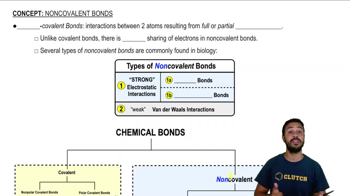
Interactions between atoms resulting from full or partial charges, without any sharing of electrons.
진행 상황 추적
컨트롤 버튼이 '내비게이션' 모드로 변경되었습니다.
1/13
관련 플래시카드
관련 실천
추천 영상
Noncovalent Bonds quiz
Noncovalent Bonds
15 용어
Noncovalent Bonds
3. Chemical Principles of Microbiology
3 문제점
주제
Monica
Ionic Bonding
3. Chemical Principles of Microbiology
3 문제점
주제
Nicole
3. Chemical Principles of Microbiology
7 주제
12 문제점
장
Nicole
03:14
Noncovalent Bonds
21768
views
305
rank
이 집합의 용어 (13)
하이드의 정의
Noncovalent Bonds
Interactions between atoms resulting from full or partial charges, without any sharing of electrons.
Covalent Bonds
Connections between atoms involving the sharing of electrons, forming strong chemical links.
Electrostatic Interactions
Attractions or repulsions between charged particles, forming the basis for certain strong noncovalent bonds.
Van Der Waals Interactions
Weak attractions between molecules due to temporary partial charges, less emphasized in biology courses.
Ionic Bonds
Strong attractions between oppositely charged ions, classified as a type of noncovalent bond.
Hydrogen Bonds
Attractions involving a hydrogen atom and an electronegative atom, important in biological molecules.
Partial Charges
Uneven distribution of electrons in a molecule, leading to regions with slight positive or negative character.
Full Charges
Complete separation of electrical charge, resulting in distinct positive and negative ions.
Chemical Bonds Map
A visual guide outlining the relationships and categories of different chemical bonds discussed in lessons.
Nonpolar Covalent Bonds
Connections where electrons are shared equally between atoms, resulting in no charge separation.
Polar Covalent Bonds
Connections where electrons are shared unequally, creating regions of partial positive and negative charge.
Atoms
Basic units of matter that interact to form various types of chemical bonds, including noncovalent ones.
Ions
Atoms or molecules carrying a net electrical charge due to loss or gain of electrons, central to ionic bonds.
 뒤로뒤로
뒤로뒤로
 03:14
03:14