Skip to main content
Microbiology
나의 코스
배우기
시험 준비
AI 튜터
학습 가이드
교과서적 해결책
플래시카드
탐험해 보세요
앱을 사용해 보세요
나의 코스
배우기
시험 준비
AI 튜터
학습 가이드
교과서적 해결책
플래시카드
탐험해 보세요
앱을 사용해 보세요
뒤로
Pentose-Phosphate Pathway quiz
카드를 뒤집기 위해 탭할 수 있습니다.
What is the main function of the Pentose Phosphate Pathway (PPP)?
카드를 뒤집기 위해 탭할 수 있습니다.
👆
What is the main function of the Pentose Phosphate Pathway (PPP)?
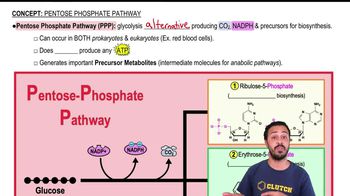
The PPP is an alternative to glycolysis that produces NADPH, carbon dioxide, and important precursor metabolites for biosynthetic reactions.
진행 상황 추적
컨트롤 버튼이 '내비게이션' 모드로 변경되었습니다.
1/15
관련 플래시카드
관련 실천
추천 영상
Pentose-Phosphate Pathway definitions
Pentose-Phosphate Pathway
13 용어
Pentose-Phosphate Pathway
12. Microbial Metabolism
3 문제점
주제
Monica
Pyruvate Oxidation
12. Microbial Metabolism
3 문제점
주제
Nicole
12. Microbial Metabolism - Part 1 of 3
9 주제
14 문제점
장
Nicole
12. Microbial Metabolism - Part 2 of 3
6 주제
13 문제점
장
Nicole
12. Microbial Metabolism - Part 3 of 3
8 주제
13 문제점
장
Monica
04:44
Pentose-Phosphate Pathway
2399
views
22
rank
이 집합의 용어 (15)
하이드의 정의
What is the main function of the Pentose Phosphate Pathway (PPP)?
The PPP is an alternative to glycolysis that produces NADPH, carbon dioxide, and important precursor metabolites for biosynthetic reactions.
Does the Pentose Phosphate Pathway produce ATP?
No, the PPP does not produce ATP; it generates precursor metabolites and NADPH instead.
What important electron carrier is produced by the PPP?
The PPP produces NADPH, which is essential for biosynthetic reactions.
In which types of cells does the Pentose Phosphate Pathway occur?
The PPP occurs in both prokaryotes and eukaryotes, including red blood cells.
What is ribulose 5-phosphate, and why is it important?
Ribulose 5-phosphate is a precursor metabolite produced by the PPP, and it is important for nucleotide biosynthesis.
Which amino acids are synthesized using erythrose 5-phosphate from the PPP?
Erythrose 5-phosphate is used to synthesize aromatic amino acids such as Tyrosine and Tryptophan.
How does the PPP connect to glycolysis?
The PPP produces glyceraldehyde 3-phosphate (G3P), which is a glycolysis intermediate and can feed back into glycolysis.
What are precursor metabolites, and why are they important in the PPP?
Precursor metabolites are intermediate molecules used in anabolic pathways to build cell molecules and structures; the PPP generates several of these.
What is the significance of NADPH produced by the PPP?
NADPH is an electron carrier crucial for biosynthetic (anabolic) reactions in the cell.
What is the fate of G3P produced by the PPP?
G3P can be fed back into the energy harvest phase of glycolysis to continue cellular respiration.
What is the role of the PPP in nucleotide biosynthesis?
The PPP produces ribulose 5-phosphate, which is necessary for the synthesis of nucleotides used in DNA and RNA.
What gas is released as a byproduct of the PPP?
Carbon dioxide (CO2) is released as a byproduct of the PPP.
Why is the PPP considered an alternative to glycolysis?
The PPP provides a different pathway for glucose breakdown, focusing on producing NADPH and precursor metabolites rather than ATP.
What is the importance of erythrose 5-phosphate in the cell?
Erythrose 5-phosphate is a precursor for the biosynthesis of specific amino acids, especially aromatic ones.
How does the PPP support anabolic pathways?
The PPP generates NADPH and precursor metabolites needed for building cell molecules and structures in anabolic pathways.
 뒤로뒤로
뒤로뒤로
 04:44
04:44