Skip to main content
Microbiology
나의 코스
배우기
시험 준비
AI 튜터
학습 가이드
교과서적 해결책
플래시카드
탐험해 보세요
앱을 사용해 보세요
나의 코스
배우기
시험 준비
AI 튜터
학습 가이드
교과서적 해결책
플래시카드
탐험해 보세요
앱을 사용해 보세요
뒤로
Simple and Facilitated Diffusion quiz
카드를 뒤집기 위해 탭할 수 있습니다.
What is passive transport and does it require energy input?
카드를 뒤집기 위해 탭할 수 있습니다.
👆
What is passive transport and does it require energy input?
Passive transport is the movement of molecules across the membrane without energy input; it does not require any energy.
진행 상황 추적
컨트롤 버튼이 '내비게이션' 모드로 변경되었습니다.
1/15
관련 플래시카드
관련 실천
추천 영상
Simple and Facilitated Diffusion definitions
Simple and Facilitated Diffusion
14 용어
Simple and Facilitated Diffusion
6. Cell Membrane & Transport
5 문제점
주제
Brendan
Active Transport
6. Cell Membrane & Transport
4 문제점
주제
Monica
6. Cell Membrane & Transport - Part 1 of 2
7 주제
12 문제점
장
Monica
6. Cell Membrane & Transport - Part 2 of 2
8 주제
13 문제점
장
Brendan
04:59
Simple and Facilitated Diffusion
21385
views
299
rank
04:49
Transport Proteins of Facilitated Diffusion
17827
views
230
rank
이 집합의 용어 (15)
하이드의 정의
What is passive transport and does it require energy input?
Passive transport is the movement of molecules across the membrane without energy input; it does not require any energy.
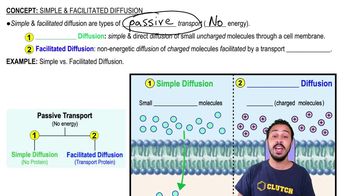
In which direction do molecules move during simple and facilitated diffusion?
Molecules move down their concentration gradients, from areas of high concentration to areas of low concentration.
What type of molecules can pass through the membrane via simple diffusion?
Small, uncharged molecules can pass directly through the cell membrane via simple diffusion.
Does simple diffusion require the assistance of transport proteins?
No, simple diffusion does not require any transport proteins.
What type of molecules typically require facilitated diffusion to cross the membrane?
Charged molecules or ions typically require facilitated diffusion to cross the membrane.
What is the main difference between simple diffusion and facilitated diffusion?
Simple diffusion does not require transport proteins, while facilitated diffusion requires transport proteins to assist molecule movement.
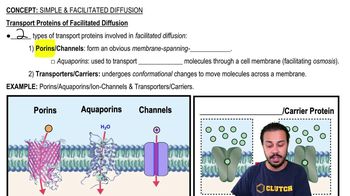
Name the two main types of transport proteins involved in facilitated diffusion.
The two main types are porins (channels) and transporters (carriers).
How do porins (channels) facilitate diffusion across the membrane?
Porins form membrane-spanning tunnels that allow molecules to pass through the membrane.
What is the specific function of aquaporins?
Aquaporins are porins that specifically facilitate the rapid movement of water molecules across the membrane, enhancing osmosis.
How do transporter (carrier) proteins move molecules across the membrane?
Transporters undergo conformational changes and are only open to one side of the membrane at a time, moving molecules across by changing shape.
Do facilitated diffusion processes require energy input?
No, facilitated diffusion is a passive process and does not require energy input.
What is the role of ion channels in facilitated diffusion?
Ion channels are a type of porin that allow charged ions to move through the membrane down their concentration gradients.
Why can't ions cross the membrane via simple diffusion?
Ions are charged and cannot pass through the hydrophobic core of the membrane without the help of transport proteins.
What does it mean for a transporter to undergo a conformational change?
It means the transporter changes its shape to move a molecule from one side of the membrane to the other.
How are porins and transporters similar in their function?
Both porins and transporters facilitate the passive movement of molecules down their concentration gradients without energy input.
 뒤로뒤로
뒤로뒤로
 04:59
04:59