Skip to main content
Microbiology
나의 코스
배우기
시험 준비
AI 튜터
학습 가이드
교과서적 해결책
플래시카드
탐험해 보세요
앱을 사용해 보세요
나의 코스
배우기
시험 준비
AI 튜터
학습 가이드
교과서적 해결책
플래시카드
탐험해 보세요
앱을 사용해 보세요
뒤로
Steps of the Inflammatory Response quiz
카드를 뒤집기 위해 탭할 수 있습니다.
What is the first step of the inflammatory response?
카드를 뒤집기 위해 탭할 수 있습니다.
👆
What is the first step of the inflammatory response?
The first step is tissue damage and infection, which allows microbes to bypass the first line of innate immunity.
진행 상황 추적
컨트롤 버튼이 '내비게이션' 모드로 변경되었습니다.
1/15
관련 플래시카드
관련 실천
추천 영상
Steps of the Inflammatory Response definitions
Steps of the Inflammatory Response
14 용어
Steps of the Inflammatory Response
19. Innate Immunity
4 문제점
주제
Nicole
Fever
19. Innate Immunity
4 문제점
주제
Nicole
19. Innate Immunity - Part 1 of 3
9 주제
12 문제점
장
Brendan
19. Innate Immunity - Part 2 of 3
10 주제
11 문제점
장
Nicole
19. Innate Immunity - Part 3 of 3
5 주제
11 문제점
장
Nicole
02:15
2) Release of Inflammatory Mediators & Other Cytokines
2681
views
24
rank
02:10
Damaging Effects of the Inflammatory Response
1188
views
8
rank
02:39
3) Vasodilation
2060
views
12
rank
이 집합의 용어 (15)
하이드의 정의
What is the first step of the inflammatory response?
The first step is tissue damage and infection, which allows microbes to bypass the first line of innate immunity.
What immediate action do blood vessels take after tissue injury and why?
Blood vessels briefly constrict (vasoconstriction) to prevent blood loss.
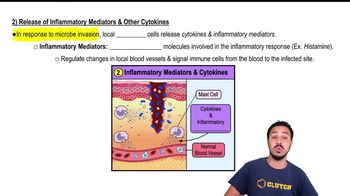
Which cells are already present in tissues and release inflammatory mediators upon infection?
Mast cells are present in tissues and release cytokines and inflammatory mediators when infection occurs.
What is the role of cytokines and inflammatory mediators in the inflammatory response?
They promote inflammation, regulate changes in local blood vessels, and attract immune cells to the infection site.
What is histamine and what does it do during inflammation?
Histamine is an inflammatory mediator that promotes inflammation and causes blood vessels to dilate.
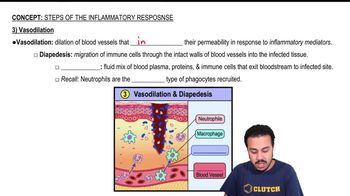
What is the third step of the inflammatory response called, and what happens during it?
The third step is vasodilation, where blood vessels enlarge and become more permeable to allow immune cells to reach the infection site.
What is diapedesis?
Diapedesis is the migration of immune cells through the intact walls of blood vessels into infected tissue.
Which immune cells are the first to be recruited to the site of infection?
Neutrophils are the first phagocytes recruited to the site of infection.
What is exudate in the context of inflammation?
Exudate is the fluid mixture of blood plasma, proteins, and immune cells that exits the bloodstream to the infected site.
What is the fourth and final step of the inflammatory response?
The fourth step is the removal of invading microbes by phagocytic cells like neutrophils and macrophages.
How do neutrophils and macrophages eliminate microbes during inflammation?
Neutrophils remove microbes through degranulation or phagocytosis, while macrophages engulf and destroy microbes and dead cells.
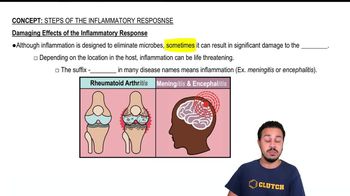
Why can the inflammatory response sometimes be damaging to the host?
Inflammation can cause accidental damage to host tissues, similar to how a sprinkler system can damage equipment while stopping a fire.
What does the suffix '-itis' indicate in medical terms?
The suffix '-itis' means inflammation, as seen in terms like meningitis and arthritis.
Why can inflammation in certain locations, like the brain, be life-threatening?
Inflammation in critical areas such as the brain can disrupt essential functions and become life-threatening.
What are two examples of diseases with the '-itis' suffix, and what do they mean?
Meningitis is inflammation of the meninges, and rheumatoid arthritis is inflammation of the joints.
 뒤로뒤로
뒤로뒤로
 02:15
02:15