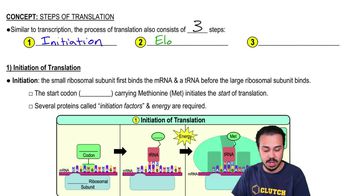
The first stage where the small ribosomal subunit, mRNA, and initiator tRNA assemble before the large subunit joins, setting the stage for protein synthesis.
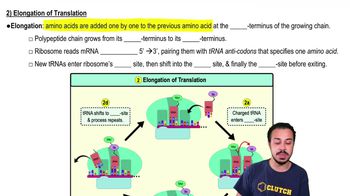
Elongation
The middle phase where amino acids are sequentially added to the growing polypeptide chain as the ribosome moves along mRNA.
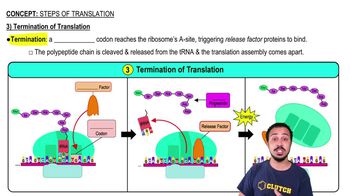
Termination
The final phase where a stop codon triggers release factors, leading to the release of the polypeptide and disassembly of the translation complex.
Ribosome
A molecular machine composed of small and large subunits that coordinates the decoding of mRNA into a polypeptide chain.
mRNA
A nucleic acid strand carrying codons that dictate the amino acid sequence during protein synthesis.
tRNA
A molecule with an anticodon that pairs with mRNA codons and delivers specific amino acids to the ribosome.
Codon
A sequence of three nucleotides on mRNA that specifies a particular amino acid or signals termination.
Anticodon
A three-nucleotide sequence on tRNA that is complementary to an mRNA codon, ensuring correct amino acid placement.
Start Codon
The specific mRNA triplet (AUG) that signals the beginning of translation and codes for methionine.
Stop Codon
A nucleotide triplet (e.g., UGA) on mRNA that signals the end of translation, not recognized by tRNA.
Polypeptide Chain
A linear sequence of amino acids linked by peptide bonds, synthesized during translation.
Peptide Bond
A covalent linkage formed between adjacent amino acids during the elongation phase.
Initiation Factors
Proteins that assist in assembling the translation initiation complex and require energy input.
Release Factor
A protein that recognizes stop codons and promotes the release of the newly synthesized polypeptide.
A Site
The ribosomal region where incoming charged tRNAs first bind during elongation.
P Site
The ribosomal region where the growing polypeptide is held and peptide bonds are formed.
E Site
The ribosomal region where discharged tRNAs exit after their amino acid has been added to the chain.
 뒤로
뒤로
 04:59
04:59