Skip to main content
Microbiology
나의 코스
배우기
시험 준비
AI 튜터
학습 가이드
교과서적 해결책
플래시카드
탐험해 보세요
앱을 사용해 보세요
나의 코스
배우기
시험 준비
AI 튜터
학습 가이드
교과서적 해결책
플래시카드
탐험해 보세요
앱을 사용해 보세요
뒤로
Steps to DNA Cloning quiz
카드를 뒤집기 위해 탭할 수 있습니다.
What are the two main steps involved in DNA cloning?
카드를 뒤집기 위해 탭할 수 있습니다.
👆
What are the two main steps involved in DNA cloning?
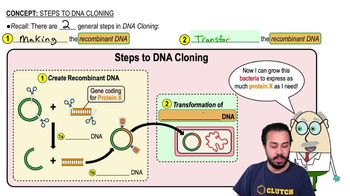
The two main steps are creating recombinant DNA and transforming the recombinant DNA into bacteria.
진행 상황 추적
컨트롤 버튼이 '내비게이션' 모드로 변경되었습니다.
1/15
관련 플래시카드
관련 실천
추천 영상
Steps to DNA Cloning definitions
Steps to DNA Cloning
14 용어
Steps to DNA Cloning
17. Biotechnology
4 문제점
주제
Nicole
Introduction to Polymerase Chain Reaction
17. Biotechnology
4 문제점
주제
Nicole
17. Biotechnology
10 주제
14 문제점
장
Brendan
04:42
Steps to DNA Cloning
6424
views
63
rank
04:58
1b) Use Ligation Enzymes
5112
views
48
rank
03:27
1a) Use Restriction Enzymes
5861
views
47
rank
이 집합의 용어 (15)
하이드의 정의
What are the two main steps involved in DNA cloning?
The two main steps are creating recombinant DNA and transforming the recombinant DNA into bacteria.
What is recombinant DNA?
Recombinant DNA is a single molecule that contains DNA from two different sources.
What enzyme is used to cut DNA during the creation of recombinant DNA?
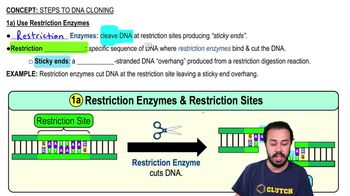
Restriction enzymes are used to cut DNA at specific sequences called restriction sites.
What are restriction sites?
Restriction sites are specific DNA sequences where restriction enzymes bind and cut the DNA.
What are sticky ends in DNA cloning?
Sticky ends are single-stranded DNA overhangs produced by restriction enzyme cuts, which facilitate joining DNA fragments.
What enzyme is used to join DNA fragments during recombinant DNA creation?
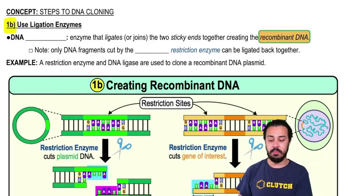
DNA ligase enzymes covalently join the sticky ends of DNA fragments.
Why can only DNA fragments cut by the same restriction enzyme be ligated together?
Only fragments cut by the same restriction enzyme have compatible sticky ends that can be joined by DNA ligase.
What is the purpose of transformation in DNA cloning?
Transformation allows bacteria to uptake recombinant DNA, making them transgenic organisms.
What is a transgenic organism in the context of DNA cloning?
A transgenic organism is one that has received and expresses recombinant DNA from a different species.
How can scientists identify bacteria that have successfully taken up recombinant DNA?
Scientists use phenotypic markers, such as antibiotic resistance, to identify transformed bacteria.
What is a cloning vector in DNA cloning?
A cloning vector is a recombinant DNA molecule used to carry the gene of interest into a host cell.
What medical application is mentioned for DNA cloning?
DNA cloning is used to produce proteins like insulin in transgenic bacteria for diabetic patients.
How is human insulin produced using DNA cloning?
The human insulin gene is inserted into a bacterial plasmid, transformed into bacteria, which then express and produce insulin.
What happens to bacteria after they are transformed with recombinant DNA containing the insulin gene?
The bacteria replicate, each containing the recombinant DNA, and express the human insulin gene.
What is the final product obtained from transgenic bacteria in the context of insulin production?
The final product is purified human insulin protein, which can be used to treat diabetic patients.
 뒤로뒤로
뒤로뒤로
 04:42
04:42