Skip to main content
Microbiology
나의 코스
배우기
시험 준비
AI 튜터
학습 가이드
교과서적 해결책
플래시카드
탐험해 보세요
앱을 사용해 보세요
나의 코스
배우기
시험 준비
AI 튜터
학습 가이드
교과서적 해결책
플래시카드
탐험해 보세요
앱을 사용해 보세요
뒤로
Symbiotic Relationships quiz
카드를 뒤집기 위해 탭할 수 있습니다.
What is symbiosis in biology?
카드를 뒤집기 위해 탭할 수 있습니다.
👆
What is symbiosis in biology?
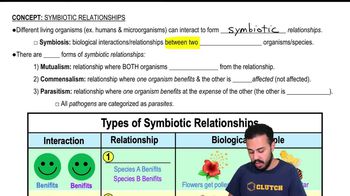
Symbiosis refers to the specific biological interactions or relationships between two different organisms or species.
진행 상황 추적
컨트롤 버튼이 '내비게이션' 모드로 변경되었습니다.
1/15
관련 플래시카드
관련 실천
추천 영상
Symbiotic Relationships definitions
Symbiotic Relationships
14 용어
Symbiotic Relationships
21. Principles of Disease
5 문제점
주제
Brendan
The Human Microbiome
21. Principles of Disease
7 문제점
주제
Nicole
21. Principles of Disease - Part 1 of 3
5 주제
12 문제점
장
Brendan
21. Principles of Disease - Part 2 of 3
6 주제
12 문제점
장
Brendan
21. Principles of Disease - Part 3 of 3
9 주제
12 문제점
장
Monica
05:59
Symbiotic Relationships
3070
views
59
rank
이 집합의 용어 (15)
하이드의 정의
What is symbiosis in biology?
Symbiosis refers to the specific biological interactions or relationships between two different organisms or species.
Name the three main forms of symbiotic relationships.
The three main forms are mutualism, commensalism, and parasitism.
In mutualism, how are the organisms affected?
In mutualism, both organisms benefit from the relationship.
Give an example of a mutualistic relationship.
An example is the relationship between flowers and honeybees, where flowers are pollinated and bees collect nectar.
How does commensalism differ from mutualism?
In commensalism, one organism benefits while the other is unaffected, whereas in mutualism both benefit.
What is an example of commensalism?
Barnacles on whales is an example; barnacles benefit from transportation, while whales are unaffected.
Describe parasitism in terms of organism benefit and harm.
In parasitism, one organism benefits at the expense of the other, which is harmed.
What is an example of a parasitic relationship?
Ticks feeding on dogs is an example; ticks gain nutrients while dogs lose blood and may be harmed.
How are pathogens categorized in terms of symbiotic relationships?
All pathogens are categorized as parasites because they benefit by harming their host.
In commensalism, what happens to the organism that does not benefit?
The organism that does not benefit remains unaffected; it is neither helped nor harmed.
Why do barnacles benefit from attaching to whales?
Barnacles benefit by using whales for transportation, which helps them access food.
How does the relationship between ticks and dogs illustrate parasitism?
Ticks benefit by feeding on the dog's blood, while the dog is harmed by blood loss and potential infection.
What do both species gain in a mutualistic relationship?
Both species gain benefits that help them survive or thrive.
Can you name a mutualistic relationship involving plants?
Yes, flowers and honeybees have a mutualistic relationship where both benefit.
What is the main difference between commensalism and parasitism?
In commensalism, one organism benefits and the other is unaffected, while in parasitism, one benefits and the other is harmed.
 뒤로뒤로
뒤로뒤로
 05:59
05:59