Skip to main content
Microbiology
나의 코스
배우기
시험 준비
AI 튜터
학습 가이드
교과서적 해결책
플래시카드
탐험해 보세요
앱을 사용해 보세요
나의 코스
배우기
시험 준비
AI 튜터
학습 가이드
교과서적 해결책
플래시카드
탐험해 보세요
앱을 사용해 보세요
뒤로
T Dependent & T Independent Antigens definitions
카드를 뒤집기 위해 탭할 수 있습니다.
T Dependent Antigen
카드를 뒤집기 위해 탭할 수 있습니다.
👆
T Dependent Antigen
Molecule requiring helper T cells for naive B cell activation, leading to antibody production and memory cell formation.
진행 상황 추적
컨트롤 버튼이 '내비게이션' 모드로 변경되었습니다.
1/15
관련 플래시카드
관련 실천
추천 영상
T Dependent & T Independent Antigens quiz
T Dependent & T Independent Antigens
15 용어
T Dependent & T Independent Antigens
20. Adaptive Immunity
5 문제점
주제
Nicole
Clonal Selection
20. Adaptive Immunity
3 문제점
주제
Nicole
20. Adaptive Immunity - Part 1 of 3
7 주제
12 문제점
장
Brendan
20. Adaptive Immunity - Part 2 of 3
6 주제
13 문제점
장
Brendan
20. Adaptive Immunity - Part 3 of 3
7 주제
13 문제점
장
Brendan
05:09
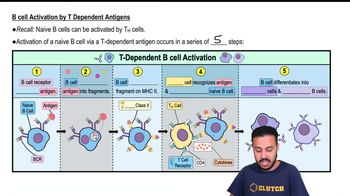
B Cell Activation by T Dependent Antigens
2011
views
20
rank
02:08
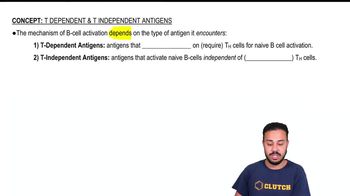
T Dependent & T Independent Antigens
2489
views
33
rank
03:11
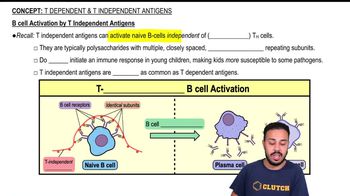
B Cell Activation by T Independent Antigens
1499
views
11
rank
이 집합의 용어 (15)
하이드의 정의
T Dependent Antigen
Molecule requiring helper T cells for naive B cell activation, leading to antibody production and memory cell formation.
T Independent Antigen
Molecule, often a long polysaccharide, capable of activating naive B cells without helper T cell involvement.
Naive B Cell
Immune cell that has not yet encountered its specific antigen and requires activation to function.
Helper T Cell
Lymphocyte that assists in activating naive B cells by recognizing antigens presented on MHC Class II molecules.
B Cell Receptor
Surface protein on B cells responsible for binding specific antigens, initiating the activation process.
MHC Class II Molecule
Cell surface protein complex presenting processed antigen fragments to helper T cells for immune recognition.
Antigen Fragmentation
Process where internalized antigens are broken into smaller pieces within B cells for presentation.
Cytokine
Signaling molecule released by helper T cells that stimulates B cell activation and differentiation.
Plasma Cell
Differentiated B cell specialized in secreting large amounts of antibodies during immune responses.
Memory B Cell
Long-lived B cell formed after activation, providing rapid antibody response upon future antigen exposure.
Antibody
Protein secreted by plasma cells that specifically binds antigens to neutralize or mark them for destruction.
Polysaccharide
Long carbohydrate molecule with repeating subunits, often forming the structure of T independent antigens.
CD4 Molecule
Surface protein on helper T cells that aids in recognizing antigens presented by MHC Class II molecules.
T Cell Receptor
Surface molecule on helper T cells that detects antigen fragments displayed by MHC Class II complexes.
Pathogen
Disease-causing organism, some of which possess T independent antigens, increasing risk in young children.
 뒤로뒤로
뒤로뒤로
 05:09
05:09