Skip to main content
Microbiology
나의 코스
배우기
시험 준비
AI 튜터
학습 가이드
교과서적 해결책
플래시카드
탐험해 보세요
앱을 사용해 보세요
나의 코스
배우기
시험 준비
AI 튜터
학습 가이드
교과서적 해결책
플래시카드
탐험해 보세요
앱을 사용해 보세요
뒤로
The Griffith Experiment definitions
카드를 뒤집기 위해 탭할 수 있습니다.
Griffith Experiment
카드를 뒤집기 위해 탭할 수 있습니다.
👆
Griffith Experiment
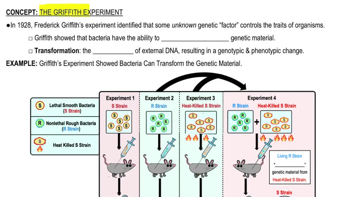
A 1928 study revealing that bacteria can acquire genetic traits from external sources, leading to changes in their characteristics.
진행 상황 추적
컨트롤 버튼이 '내비게이션' 모드로 변경되었습니다.
1/15
관련 플래시카드
관련 실천
추천 영상
The Griffith Experiment quiz #1
The Griffith Experiment
10 용어
The Griffith Experiment
14. DNA Replication
3 문제점
주제
Nicole
The Hershey-Chase Experiment
14. DNA Replication
3 문제점
주제
Monica
14. DNA Replication
10 주제
14 문제점
장
Brendan
08:56
The Griffith Experiment
17759
views
261
rank
이 집합의 용어 (15)
하이드의 정의
Griffith Experiment
A 1928 study revealing that bacteria can acquire genetic traits from external sources, leading to changes in their characteristics.
Transformation
The process where bacteria uptake external DNA, resulting in changes to both genotype and phenotype.
S Strain
A lethal, smooth-surfaced pneumococcus variant with a capsule, capable of killing mice in experiments.
R Strain
A nonlethal, rough-surfaced pneumococcus variant lacking a capsule, unable to kill mice.
Capsule
A protective outer layer found on certain bacteria, contributing to their smooth appearance and virulence.
Heat-Killed S Strain
A form of the lethal smooth bacteria rendered nonviable by exposure to high temperatures, unable to reproduce or cause disease.
Genetic Material
The substance responsible for controlling traits in organisms, later identified as DNA.
Phenotypic Change
An observable alteration in an organism's traits resulting from the acquisition of new genetic information.
Genotypic Change
A modification in the genetic composition of an organism due to the uptake of external DNA.
Oswald Avery
A scientist who, along with colleagues, identified DNA as the transforming substance in bacterial transformation.
DNA
A molecule later proven to be the hereditary material responsible for transmitting genetic information in living organisms.
Protein
A macromolecule once considered a candidate for genetic material due to its complexity and abundance in cells.
Virulence
The degree to which a microorganism can cause disease, often influenced by structural features like capsules.
Uptake
The absorption of external genetic material by a living cell, leading to transformation.
Skepticism
The scientific doubt regarding DNA's role as genetic material, prevalent before its function was fully established.
 뒤로뒤로
뒤로뒤로
 08:56
08:56