Skip to main content
Microbiology
나의 코스
배우기
시험 준비
AI 튜터
학습 가이드
교과서적 해결책
플래시카드
탐험해 보세요
앱을 사용해 보세요
나의 코스
배우기
시험 준비
AI 튜터
학습 가이드
교과서적 해결책
플래시카드
탐험해 보세요
앱을 사용해 보세요
뒤로
Transplantation definitions
카드를 뒤집기 위해 탭할 수 있습니다.
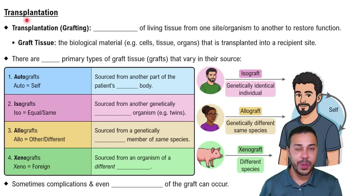
Autograft
카드를 뒤집기 위해 탭할 수 있습니다.
👆
Autograft
Tissue transplanted from one part of a person's body to another part of the same individual, eliminating immune rejection risk.
진행 상황 추적
컨트롤 버튼이 '내비게이션' 모드로 변경되었습니다.
1/15
관련 플래시카드
관련 실천
추천 영상
Transplantation quiz
Transplantation
15 용어
Transplantation
27. Immunological Disorders
3 문제점
주제
27. Immunological Disorders - Part 1 of 2
4 주제
11 문제점
장
27. Immunological Disorders - Part 2 of 2
4 주제
6 문제점
장
03:09
Graft-Versus-Host Disease (GVHD)
142
views
3
rank
04:07
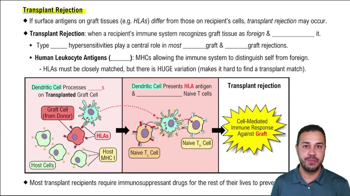
Transplant Rejection
126
views
2
rank
04:21
Transplantation
101
views
3
rank
이 집합의 용어 (15)
하이드의 정의
Autograft
Tissue transplanted from one part of a person's body to another part of the same individual, eliminating immune rejection risk.
Isograft
Tissue transferred between genetically identical individuals, such as identical twins, resulting in minimal immune response.
Allograft
Tissue transplanted between genetically different members of the same species, often requiring immunosuppression to prevent rejection.
Xenograft
Tissue or organ transplanted from a donor of a different species, such as a pig heart valve into a human recipient.
Graft
Biological material, including tissues, organs, or cells, transferred to restore function in a recipient.
Transplant Rejection
Immune response where recipient cells recognize donor antigens as foreign, leading to attack and possible graft failure.
Human Leukocyte Antigen
Cell surface proteins, also known as MHC molecules, crucial for distinguishing self from non-self in transplantation.
MHC Molecule
Major proteins on cell surfaces that present antigens and are central to immune recognition during transplantation.
Type IV Hypersensitivity
Delayed, T cell-mediated immune reaction responsible for most transplant rejections, especially with non-identical donors.
Immunosuppressant
Medication used to dampen the immune response, often required lifelong after transplantation to prevent rejection.
Bone Marrow Transplant
Procedure replacing impaired marrow with donor cells, effectively transferring a new immune system to the recipient.
Graft-versus-Host Disease
Complication where donor immune cells attack recipient tissues after bone marrow transplantation, causing organ inflammation.
Dendritic Cell
Immune cell that processes and presents donor antigens to T cells, initiating transplant rejection.
Cytotoxic T Cell
Immune cell activated during rejection, responsible for attacking and destroying transplanted graft cells.
HLA Matching
Process of selecting donors with similar human leukocyte antigens to minimize immune-mediated graft rejection.
 뒤로뒤로
뒤로뒤로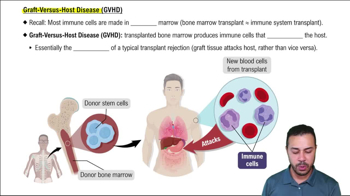
 03:09
03:09