 뒤로
뒤로Adaptive Immunity and Host Responses in Microbiology
 04:57
04:57
이 집합의 용어 (28)
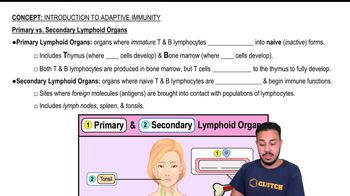
Red bone marrow and thymus where lymphocytes mature.
Include lymph nodes, spleen, tonsils, and MALT where immune responses are initiated.
A specific part of an antigen recognized by immune cells; can be exogenous, endogenous, or autoantigens.
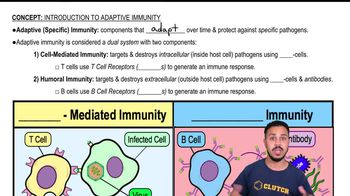
Present on all nucleated cells and display endogenous antigens to cytotoxic T cells.
Found on antigen-presenting cells and present exogenous antigens to helper T cells.
Destroy infected or abnormal cells by recognizing antigen presented with MHC I.
Coordinate immune responses by activating other immune cells, recognizing antigen with MHC II.
Suppress immune responses to maintain self-tolerance and prevent autoimmunity.
Process where T cells that do not recognize MHC or recognize self-antigens undergo apoptosis to prevent autoimmunity.
Composed of heavy and light chains with variable and constant regions and antigen-binding sites.
Include complement activation, neutralization, opsonization, agglutination, and ADCC.
The first antibody produced during an immune response.
The most common and longest-lasting antibody in circulation.
Found mainly in body secretions like saliva and mucus, protecting mucosal surfaces.
Involved in allergic reactions and defense against parasitic infections.
Function is not well understood but is found on B cell surfaces.
Occurs in bone marrow; self-reactive B cells may be deleted, inactivated, or change their BCR to prevent autoimmunity.
Cytokines that facilitate communication and signaling among leukocytes.
Proteins with antiviral activity that also act as cytokines to modulate immune responses.
Secreted by macrophages and T cells to kill tumor cells and regulate inflammation.
Cytokines that direct leukocyte movement toward sites of infection or injury.
Include antigen presentation, helper T cell differentiation, clonal expansion, and self-stimulation.
Mechanism used by cytotoxic T cells to induce apoptosis in infected cells.
Involve antigen presentation, helper T cell activation, B cell activation, and B cell proliferation and differentiation.
Activated B cells that produce and secrete large amounts of antibodies.
Long-lived B cells that provide faster and stronger response upon re-exposure to antigen.
Immunity gained through natural exposure to pathogens, either active (infection) or passive (maternal antibodies).
Immunity gained through medical intervention, such as vaccines (active) or antibody therapy (passive).