 뒤로
뒤로History and Fundamentals of Microbiology
 03:55
03:55

이 집합의 용어 (20)
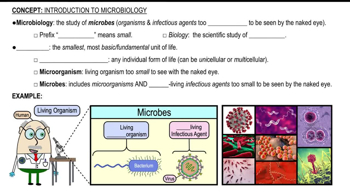
Microbiology is the science and study of microorganisms, which are very small unicellular organisms typically 1mm or less in diameter, including bacteria, fungi, viruses, archaea, and protozoa.
Invention of microscopes, disproving spontaneous generation, and demonstrating that microorganisms cause diseases.
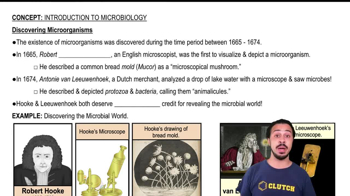
Microscopes were invented in the late 1500s and improved by Antony van Leeuwenhoek, who described the first prototype in Micrographia.
Early microscopes had magnifications ranging from 50X to 300X using double convex glass lenses.
Spontaneous generation is the disproven theory that living organisms can develop from non-living matter.
Redi showed that maggots on decaying meat came from eggs laid by flies, not spontaneously from the meat itself.
Needham heated mutton broth and observed microbial growth after cooling, supporting spontaneous generation by suggesting organic matter confers life.
He boiled sealed flasks of broth and found no microbial growth, showing air carried germs and challenging spontaneous generation.
Pasteur used a swan-neck flask to show that air could enter but microorganisms were trapped, disproving spontaneous generation.
Four criteria to link a microorganism to a disease: presence in diseased but not healthy hosts, isolation in pure culture, causing disease in healthy host, and re-isolation from diseased host.
They provide a systematic method to prove that a specific microorganism causes a particular disease.
Development of microscopes, disproving spontaneous generation, culture methods, sterilization techniques, and pure culture isolation.
Limitations in culturing unculturable microorganisms and challenges with pure cultures of pathogenic microbes like HIV and Mycobacterium tuberculosis.
The study of relationships between microorganisms and their environment, including interactions with other organisms.
Nitrogen fixation by Azotobacter and alcohol fermentation by Saccharomyces cerevisiae.
Basic microbiology (biology, physiology, genetics, taxonomy) and applied microbiology (disease, water, food, industrial applications).
Restriction endonucleases, recombinant DNA ligase, DNA sequencing, whole genome sequencing, and CRISPR-Cas systems.
Bacteriology, virology, mycology, microbial physiology, molecular biology, medical microbiology, immunology, food and industrial microbiology.
They enabled the development of solid media and methods for isolating and culturing microorganisms.
By showing that microorganisms trapped from air could grow in sterile broth and linking microbes to disease causation.