뒤로

Host Immune Responses in Microbiology

컨트롤 버튼이 '내비게이션' 모드로 변경되었습니다.
1/20
  • What are the main components of the first line of defense in the immune system?

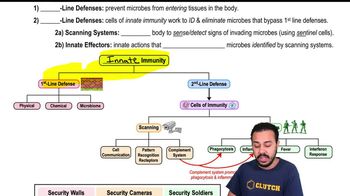
    The first line of defense includes physical and chemical barriers such as the skin (epidermis and dermis), mucous membranes, lacrimal apparatus, microbiome, and secretions in digestive, urinary, reproductive, and cardiovascular systems.
  • What role does the epidermis play in the first line of defense?

    The epidermis contains epidermal dendritic cells that help detect and respond to pathogens.
  • How do chemicals contribute to the first line of defense?

    Chemicals like antimicrobial peptides, lysozyme, and sebum destroy or inhibit pathogens on body surfaces.
  • What is the function of the lacrimal apparatus in host defense?

    The lacrimal apparatus produces tears containing lysozyme, which destroys bacteria on the eye surface.
  • How does the microbiome protect the host?

    Resident and transient microbiota compete with pathogens, making it difficult for harmful microbes to establish.
  • What are the main components of blood involved in the second line of defense?

    Plasma contains complement proteins and antibodies; leukocytes include granulocytes (basophils, eosinophils, neutrophils) and agranulocytes (lymphocytes and monocytes/macrophages).
  • Name the three types of granulocytes and their roles.

    Basophils promote inflammation, eosinophils secrete toxins to kill helminths, and neutrophils produce chemicals to kill invaders.
  • What is the role of monocytes in the immune response?

    Monocytes mature into macrophages that perform phagocytic killing of pathogens in six stages.
  • Describe the non-phagocytic killing mechanisms in the second line of defense.

    Eosinophils secrete toxins against helminths, natural killer cells kill infected or tumor cells by secreting toxins, and neutrophils produce chemicals to kill nearby invaders.
  • What are Toll-like receptors (TLRs) and their function?

    TLRs are receptors on immune cells that recognize pathogen-associated molecular patterns (PAMPs) to trigger inflammatory mediators and stimulate adaptive immunity.
  • What are pathogen-associated molecular patterns (PAMPs)?

    PAMPs are molecular structures on pathogens recognized by the immune system to initiate inflammation, adaptive responses, and apoptosis.
  • What are the three complement activation pathways?

    The classical, alternative, and lectin pathways activate complement proteins to destroy pathogens.
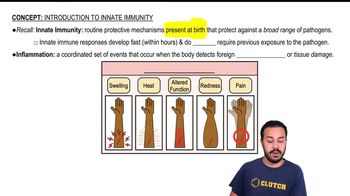
  • What happens during acute inflammation?

    Acute inflammation involves vasodilation and increased blood vessel permeability, migration of phagocytes, and tissue repair.
  • Which chemical mediators promote vasodilation in inflammation?

    Bradykinins, prostaglandins, leukotrienes, and histamine promote vasodilation during inflammation.
  • What distinguishes chronic inflammation from acute inflammation?

    Chronic inflammation is long-lasting and can cause tissue damage and disease, unlike the short-term acute inflammation.
  • How does fever contribute to host defense?

    Fever is triggered by pyrogens that stimulate the hypothalamus to raise body temperature, inhibiting pathogen growth.
  • What are common sources of pyrogens that induce fever?

    Bacterial toxins, cytoplasmic contents of bacteria, and antibody-antigen complexes act as pyrogens.
  • What is the role of interferons in immune defense?

    Interferons are signaling proteins that help protect cells from viral infections; Type I and Type II interferons have distinct roles.
  • How do natural killer cells kill infected or tumor cells?

    Natural killer cells secrete toxins that induce apoptosis in infected or tumor cells.
  • What is the significance of complement proteins in immunity?

    Complement proteins enhance phagocytosis, promote inflammation, and directly lyse pathogens.