 뒤로
뒤로Microbial Genetics and Mutation in Microbiology
 02:04
02:04
이 집합의 용어 (32)
Genetics is the study of what genes are, how they carry information, how information is expressed, and how genes are replicated.
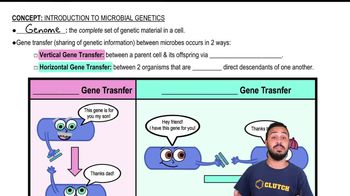
A gene is a segment of DNA that encodes a functional product, usually a protein. The genome is all the genetic material in a cell.
Genetic information flows from DNA to RNA (transcription), then RNA to protein (translation). DNA replicates before cell division, and recombination can transfer genes horizontally between cells.
DNA is a double helix with a backbone of deoxyribose phosphate. Nitrogenous bases pair as thymine with adenine and cytosine with guanine, held by hydrogen bonds. Strands are antiparallel (5' to 3' and 3' to 5').
Each new DNA molecule consists of one old (template) strand and one newly synthesized strand, preserving half of the original molecule.
DNA polymerase synthesizes new DNA strands in the 5' to 3' direction. An RNA primer initiates synthesis by providing a starting point for DNA polymerase.
The leading strand is synthesized continuously toward the replication fork; the lagging strand is synthesized discontinuously away from the fork in Okazaki fragments.
DNA polymerase removes RNA primers and fills gaps; DNA ligase seals the fragments to form a continuous strand.
Transcription is the process of making RNA from DNA. RNA polymerase binds to the promoter and synthesizes RNA in the 5' to 3' direction until reaching a terminator sequence.
Eukaryotic transcription produces RNA with exons and introns; introns are removed by ribozymes to form mature mRNA. In prokaryotes, transcription produces mRNA without introns.
Messenger RNA (mRNA), transfer RNA (tRNA), and ribosomal RNA (rRNA).
Translation is the synthesis of proteins from mRNA. It involves mRNA, tRNA (carrying amino acids), and rRNA (forming ribosomes).
The start codon is AUG, which codes for the amino acid methionine.
The stop codons are UAA, UAG, and UGA, signaling termination of protein synthesis.
In prokaryotes, transcription and translation occur simultaneously in the cytoplasm. In eukaryotes, transcription occurs in the nucleus and mRNA must exit to the cytoplasm for translation.
Constitutive enzymes are expressed at a fixed rate regardless of environmental conditions, such as enzymes for glucose metabolism.
Repressible enzymes decrease synthesis when not needed (e.g., tryptophan operon). Inducible enzymes are produced only when their substrate is present (e.g., lactose operon).
An operon is a control region including a promoter, operator, and structural genes regulated together to control gene expression.
Without lactose, the repressor binds the operator, blocking transcription. With lactose, lactose (allolactose) binds the repressor, inactivating it, allowing RNA polymerase to transcribe structural genes.
Mutations are changes in genetic material caused by spontaneous errors or mutagens such as chemicals, ionizing radiation (X-rays, gamma rays), and UV light.
A missense mutation is a base substitution that changes one amino acid in the protein sequence.
A nonsense mutation changes a codon to a stop codon, prematurely terminating protein synthesis.
A frameshift mutation results from insertion or deletion of nucleotides, shifting the reading frame and altering the entire downstream amino acid sequence.
UV radiation causes thymine-thymine dimers to form in DNA, distorting the molecule and potentially causing errors during replication.
Light repair enzymes recognize thymine dimers, cut out damaged DNA, and DNA polymerase and ligase fill and seal the gaps using the intact strand as a template.
The Ames test detects mutagenic chemicals by observing reverse mutations in histidine-dependent Salmonella, allowing growth on histidine-free media.
Transformation, conjugation, and transduction are mechanisms for gene transfer between bacteria of the same generation.
Live bacteria take up fragmented DNA from dead cells and incorporate it into their genome, becoming genetically transformed.
Conjugation transfers plasmids from an F+ donor cell to an F- recipient via a sex pilus, converting the recipient to F+.
An Hfr cell has the F plasmid integrated into its chromosome and can transfer chromosomal genes to a recipient during conjugation.
Transduction occurs when bacteriophages transfer bacterial DNA from a donor to a recipient cell, creating recombinant bacteria.
Plasmids are extrachromosomal DNA that enhance bacterial traits. Types include conjugative plasmids (carry sex pili genes), dissimilation plasmids (catabolism enzymes), and R factors (antibiotic resistance).