 뒤로
뒤로Microbiology Fundamentals
 03:55
03:55

이 집합의 용어 (26)
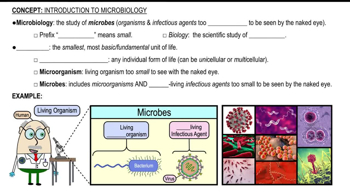
Microbiology is the study of microorganisms, including bacteria, viruses, fungi, and protozoa.
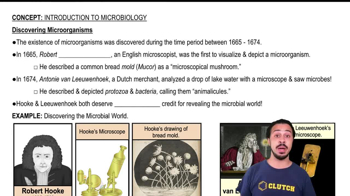
Leeuwenhoek discovered microorganisms using a microscope, founding the field of microbiology.
Bacteria, archaea, viruses, fungi, protozoa, and algae.
Microbes can cause disease, aid digestion, produce food and medicine, and recycle nutrients.
Redi showed that maggots on meat came from flies, disproving spontaneous generation for large organisms.
Pasteur disproved spontaneous generation for microbes and developed pasteurization.
A systematic process of observation, hypothesis, experimentation, and conclusion to investigate phenomena.
To prove the cause of an infectious disease by linking a specific microbe to the disease.
Gram developed the Gram stain, a method to classify bacteria by cell wall properties.
They advanced public health: Semmelweis promoted handwashing, Lister antiseptics, Nightingale nursing hygiene, Snow epidemiology.
Jenner developed the first vaccine using cowpox to prevent smallpox.
Ehrlich developed the concept of a 'magic bullet' to target microbes without harming the host.
Matter is anything with mass and volume; an atom is the smallest unit of an element; an element is a pure substance made of one type of atom.
Protons are positively charged particles in the nucleus, neutrons are neutral particles in the nucleus, electrons are negatively charged particles orbiting the nucleus.
Atomic number = number of protons; mass number = protons + neutrons; isotope = atoms with same protons but different neutrons; radioisotope = unstable isotope that emits radiation.
Ionic bonds transfer electrons; nonpolar covalent bonds share electrons equally; polar covalent bonds share electrons unequally.
Electronegativity difference between atoms determines if a covalent bond is polar or nonpolar.
Hydrogen bonds are weak attractions between a hydrogen atom and electronegative atoms; important for water properties and biomolecule structure.
Dehydration synthesis joins molecules by removing water; hydrolysis breaks molecules by adding water.
Ice is less dense than liquid water because hydrogen bonds form a lattice structure that holds molecules apart.
Solute is the substance dissolved; solvent is the dissolving medium; solution is the homogeneous mixture of solute and solvent.
Acids release H+; bases release OH-; salts are ionic compounds from acid-base reactions.
pH measures acidity/basicity; buffers maintain stable pH by neutralizing added acids or bases.
Carbohydrates (monosaccharides), lipids (fatty acids), proteins (amino acids), nucleic acids (nucleotides).
Carbohydrates: energy; lipids: energy storage and membranes; proteins: structure and enzymes; nucleic acids: genetic information.
Primary (amino acid sequence), secondary (alpha helices/beta sheets), tertiary (3D folding), quaternary (multiple polypeptides).