뒤로

Microbiology Key Concepts and Contributions

컨트롤 버튼이 '내비게이션' 모드로 변경되었습니다.
1/20
  • Contributions of scientists to microbiology and medicine

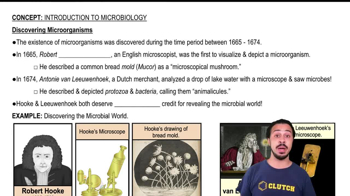
    • Discovery of microbes by Antonie van Leeuwenhoek
    • Germ theory of disease by Louis Pasteur
    • Development of vaccines by Edward Jenner
  • Spontaneous Generation concept

    Rejected by experiments of Pasteur and Redi showing life arises from existing life, not spontaneously.
  • Contributions of microbes to medicine and microbiology

    • Production of antibiotics
    • Role in fermentation and food production
    • Microbiome's impact on human health
  • Difference between element, atom, molecule, and compound

    Element: pure substance of one type of atom.
    Atom: smallest unit of an element.
    Molecule: two or more atoms bonded.
    Compound: molecule with different elements.
  • Types of chemical bonds and examples

    Intra-molecular bonds: covalent bonds within molecules (e.g., H2O).
    Inter-molecular bonds: hydrogen bonds between molecules (e.g., water molecules).
  • Effect of modifying neutrons in an atom

    Changes the isotope of the element, altering atomic mass but not chemical properties.
  • Effect of modifying electrons in an atom

    Creates ions with positive or negative charge, changing chemical reactivity.
  • Calculating pH and maintaining stability

    pH = \(-\log[H^+]\). Buffers maintain pH by neutralizing acids or bases.
  • Definition of Microbiome

    The full community of microorganisms (bacteria, viruses, fungi) living in a particular environment, especially the human body.
  • Rules of scientific nomenclature

    • Genus name capitalized
    • Species name lowercase
    • Both italicized or underlined
  • Building and breaking down macromolecules

    Building: dehydration synthesis removes water to form bonds.
    Breaking down: hydrolysis adds water to break bonds.
  • Six biological elements essential for life

    Carbon, Hydrogen, Oxygen, Nitrogen, Phosphorus, Sulfur.
  • Number of bonds biological elements can make

    • Carbon: 4
    • Hydrogen: 1
    • Oxygen: 2
    • Nitrogen: 3
    • Phosphorus: 5
    • Sulfur: 2
  • Basic structure of carbohydrates

    Ring-shaped molecules made of carbon, hydrogen, and oxygen in a 1:2:1 ratio.
  • Monomers and polymers of carbohydrates

    Monomer: monosaccharides (e.g., glucose).
    Polymer: polysaccharides (e.g., starch, glycogen).
  • Functions of carbohydrates

    • Energy source
    • Energy storage
    • Structural support
  • Basic structure of lipids

    Long hydrocarbon chains or rings, hydrophobic and nonpolar.
  • Monomers and polymers of lipids

    Monomers: fatty acids and glycerol.
    Polymers: triglycerides, phospholipids.
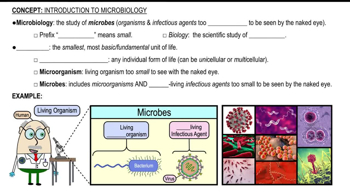
  • Organisms studied in microbiology

    Bacteria, viruses, fungi, protozoa, and microscopic algae.
  • Examples of Emerging Infectious Diseases (EIDs)

    Diseases newly appearing or increasing in incidence, e.g., COVID-19, Ebola, Zika.