뒤로

Microbiology: Microbial Control and Metabolism
컨트롤 버튼이 '내비게이션' 모드로 변경되었습니다.
1/44
  • What are Reactive Oxygen Species (ROS)?

    Harmful oxygen byproducts that damage cells.

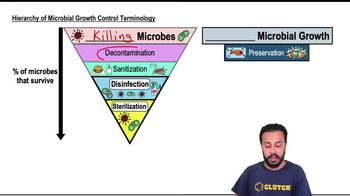
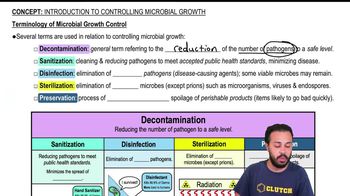
  • What is decontamination?

    Removing or reducing microorganisms.

  • What is sterilization?

    Killing all microorganisms, including endospores.

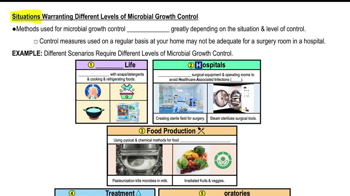
  • What is disinfection?

    Killing most disease-causing microorganisms, but not usually endospores.

  • What does an autoclave use to sterilize?

    Steam under pressure.

  • What does boiling do?

    Kills most microbes but not endospores.

  • What is pasteurization?

    Heating food or liquids to reduce pathogens.

  • What is dry heat used for?

    Sterilizing with hot air.

  • What does freezing do to microbes?

    Stops or slows growth but does not kill most microbes.

  • What does refrigeration do?

    Slows microbial growth.

  • How does radiation control microbes?

    Damages DNA.

  • What does filtration do?

    Removes microbes from liquids or air.

  • What does a low-level germicide kill?

    Most bacteria and some viruses.

  • What does an intermediate-level germicide kill?

    Bacteria, fungi, most viruses, and Mycobacterium.

  • What does a high-level germicide kill?

    Nearly all microorganisms and may kill endospores with long exposure.

  • What factors should be considered when choosing a germicide?

    Type of microbe, surface, concentration, contact time, and safety.

  • How do detergents kill microbes?

    They disrupt cell membranes.

  • How do alcohols kill microbes?

    They denature proteins and damage membranes.

  • How do phenols kill microbes?

    They damage proteins and membranes.

  • How do aldehydes kill microbes?

    They cross-link proteins and DNA.

  • How do halogens kill microbes?

    They oxidize cell components.

  • How do peroxygens kill microbes?

    They produce reactive oxygen species.

  • What is ethylene oxide used for?

    Sterilizing heat-sensitive equipment.

  • How are Mycobacteria controlled?

    High-level disinfectants or sterilization.

  • How are endospores controlled?

    Autoclaving or sterilization.

  • Which viruses are easier to kill?

    Enveloped viruses.

  • How are protozoa controlled?

    Filtration and disinfectants.

  • How are prions destroyed?

    Special chemical treatment and autoclaving or incineration.

  • What is metabolism?

    All chemical reactions in a cell.

  • What is catabolism?

    Breaking down molecules to release energy.

  • What is anabolism?

    Building molecules using energy.

  • What type of reaction is catabolism?

    Exergonic.

  • What type of reaction is anabolism?

    Endergonic.

  • What process is associated with catabolism?

    Hydrolysis.

  • What process is associated with anabolism?

    Dehydration synthesis.

  • What is an example of catabolism?

    Cellular respiration.

  • What is an example of anabolism?

    Protein synthesis.

  • What are amphibolic reactions?

    Reactions used in both catabolism and anabolism.

  • What is an example of an amphibolic pathway?

    The Krebs (Citric Acid) Cycle.

  • What is ATP?

    The cell's main energy molecule.

  • Why is ATP called the energy currency of the cell?

    It stores and releases energy quickly.

  • How is ATP regenerated?

    ADP + phosphate + energy → ATP, represented as \(\mathrm{ADP} + \mathrm{P_i} + \text{energy} \to \mathrm{ATP}\).

  • What are the three parts of ATP?

    Adenine, ribose, and three phosphate groups.

  • How does ATP release energy?

    By breaking off its last phosphate group.