 뒤로
뒤로Microbiology: The Microbial World and You
 03:55
03:55

이 집합의 용어 (24)
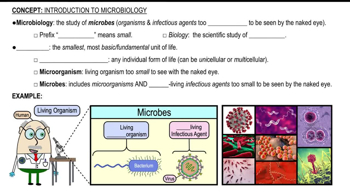
Microorganisms are organisms too small to be seen with the unaided eye, including bacteria, fungi, protozoa, microscopic algae, and viruses.
Microbes decompose organic waste, generate oxygen by photosynthesis, produce chemicals like ethanol and vitamins, create fermented foods, and contribute to manufacturing and disease treatment.
Carolus Linnaeus established scientific nomenclature in 1735, giving each organism a two-part name: genus (capitalized) and specific epithet (lowercase), both italicized or underlined.
Bacteria, Archaea, Fungi, Protozoa, Algae, Viruses, and Multicellular Animal Parasites.
Bacteria are single-celled prokaryotes with peptidoglycan cell walls, reproduce by binary fission, and may move using flagella.
Archaea are prokaryotes lacking peptidoglycan in their cell walls, often live in extreme environments, and are generally not pathogenic to humans.
Fungi are eukaryotes with chitin cell walls, absorb organic chemicals for energy, and include unicellular yeasts and multicellular molds and mushrooms.
Protozoa are eukaryotes that absorb or ingest organic chemicals, may be motile by pseudopods, cilia, or flagella, and reproduce sexually or asexually.
Algae are eukaryotes with cellulose cell walls, found in water and soil, use photosynthesis to produce oxygen and carbohydrates, and reproduce sexually or asexually.
Viruses are acellular, consist of DNA or RNA core surrounded by a protein coat, sometimes with a lipid envelope, and replicate only inside living host cells.
Eukaryotic multicellular animals, including parasitic flatworms and roundworms (helminths), with some microscopic life stages.
Bacteria, Archaea, and Eukarya (which includes protists, fungi, plants, and animals).
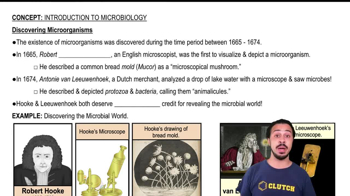
Robert Hooke reported cells in 1665; Anton van Leeuwenhoek observed microbes ('animalcules') from 1623 to 1673 using magnifying lenses.
Spontaneous generation is the disproven idea that life arises from nonliving matter; biogenesis states living cells arise only from preexisting living cells.
Pasteur demonstrated microbes are present in air and showed that sterilized nutrient broth remained microbe-free unless exposed to air, using swan-neck flasks.
Chemotherapy is the treatment of disease with chemicals, including synthetic drugs and antibiotics that inhibit or kill microbes.
In 1928, Fleming discovered penicillin, the first antibiotic produced by Penicillium fungus, which kills bacteria like Staphylococcus aureus.
Microbial genetics studies how microbes inherit traits; molecular biology studies how DNA directs protein synthesis.
Recombinant DNA is DNA made from two different sources, enabling bacteria to produce proteins like animal proteins or vaccines.
Bacteria degrade organic matter in sewage and detoxify pollutants such as oil and mercury.
Microbes pathogenic to insects, like Bacillus thuringiensis, serve as alternatives to chemical pesticides by producing toxins fatal to insects but safe for plants and animals.
Normal microbiota are microbes normally present on/in the human body that prevent pathogen growth and produce vitamins B and K.
Biofilms are microbial communities attached to surfaces, growing into masses that can cause infections and resist antibiotics.
EIDs are new or increasing diseases caused by pathogens that overcome host resistance, such as COVID-19, MERS, MRSA, and Ebola.