 뒤로
뒤로Principles of Disease and Epidemiology - Microbiology
 03:25
03:25
이 집합의 용어 (24)
Pathology is the study of disease.
Etiology is the cause of a disease.
Infection is the invasion or colonization of the body by pathogens.
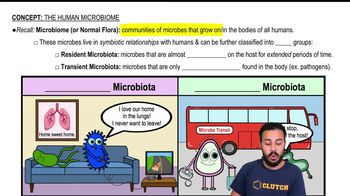
Normal microbiota permanently colonize the host without causing disease under normal conditions, while transient microbiota are present temporarily for days to months.
Microbial antagonism is competition between microbes where normal microbiota protect the host by competing for nutrients, producing harmful substances, and affecting pH and oxygen levels.
Four criteria to prove the cause of an infectious disease: presence in every case, isolation in pure culture, cause disease in healthy host, and re-isolation from inoculated host.
Some pathogens cause disease only in humans or cannot be cultured, making Koch's postulates not fully applicable.
Communicable diseases spread from one host to another; noncommunicable diseases do not.
Incidence is the number of new cases during a time period; prevalence is the total number of cases at a given time.
Herd immunity is immunity in most of a population, reducing disease spread.
Incubation period, prodromal period, period of illness, period of decline, and period of convalescence.
A continual source of infection, which can be human, animal, or nonliving.
Diseases transmitted from animals to humans, e.g., rabies from bats, plague from rodents, and malaria from mosquitoes.
Direct contact requires close association; indirect contact involves fomites (nonliving objects).
Mechanical transmission is pathogen carried on vector's feet; biological transmission involves pathogen reproduction in the vector.
Infections acquired while receiving treatment in a healthcare facility, also called nosocomial infections.
Microorganisms in the hospital environment, weakened host status, and chain of transmission in hospitals.
Staphylococcus aureus, Clostridium difficile, Enterococcus spp., Escherichia coli, Pseudomonas aeruginosa, among others.
Standard precautions are basic infection control; transmission-based precautions include contact, droplet, and airborne precautions for known or suspected infections.
The study of where and when diseases occur and how they spread in populations.
Descriptive, analytical, and experimental epidemiology.
Collects and analyzes epidemiological data and publishes reports on morbidity and mortality.
Morbidity rate is the number of people affected relative to the population; mortality rate is the number of deaths relative to the population.
Diseases that physicians are required to report to public health authorities.