Ch. 10 - Host Microbe Interactions and Pathogenesis
Norman-McKay- Microbiology: Basic and Clinical Principles 2nd Edition
Norman-McKay2nd EditionMicrobiology: Basic and Clinical PrinciplesISBN: 9780137661619당신이 사용하는 게 아니라요?교과서 변경
6장, 문제 2

Which of the following is a true statement?
a. If a pathogen establishes an infection, it is described as virulent.
b. Pathogenicity is the extent of disease caused by a microbe.
c. Normal microbiota are not usually affected by host factors.
d. A pathogen’s virulence factors change over time in response to selective pressures.
e. Attenuated pathogens cause disease in a normal host.

검증된 단계별 안내
1
Step 1: Understand the key terms involved in the question: 'virulent', 'pathogenicity', 'normal microbiota', 'virulence factors', and 'attenuated pathogens'.
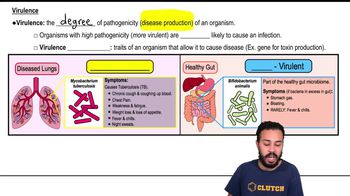
Step 2: Analyze option (a): 'If a pathogen establishes an infection, it is described as virulent.' Virulence refers to the degree of pathogenicity or the ability to cause disease, not just the establishment of infection. So, consider the difference between infection and virulence.
Step 3: Analyze option (b): 'Pathogenicity is the extent of disease caused by a microbe.' Pathogenicity is actually the ability of a microbe to cause disease, while the extent or severity of disease is called virulence. Distinguish between these two concepts.
Step 4: Analyze option (c): 'Normal microbiota are not usually affected by host factors.' Normal microbiota are influenced by host factors such as immune response, pH, and nutrient availability. So, evaluate whether this statement aligns with that knowledge.
Step 5: Analyze options (d) and (e): (d) 'A pathogen’s virulence factors change over time in response to selective pressures.' This reflects microbial adaptation and evolution, which is true. (e) 'Attenuated pathogens cause disease in a normal host.' Attenuated pathogens are weakened and typically do not cause disease in healthy hosts. Compare these to identify the true statement.

비슷한 문제에 대한 검증된 영상 답변:

이 영상 해법은 위 문제에 도움이 된다고 튜터들이 추천한 것입니다.
영상 길이:
3m
도움이 되었나요?

주요 개념

질문에 올바르게 답하기 위해 반드시 이해해야 하는 핵심 개념들은 다음과 같습니다.

Virulence and Virulent Pathogens

Virulence refers to the degree of pathogenicity or the ability of a microbe to cause disease. A pathogen that establishes an infection is not simply described as virulent; rather, virulence indicates how severe or harmful the infection can be. Virulent pathogens possess specific factors that enhance their ability to infect and damage the host.
추천 영상:

Pathogenicity vs. Virulence

Pathogenicity is the ability of a microbe to cause disease, while virulence measures the severity or extent of the disease caused. Pathogenicity is a qualitative trait (can cause disease or not), whereas virulence is quantitative, indicating how much damage the pathogen inflicts on the host.
추천 영상:

Normal Microbiota and Host Factors

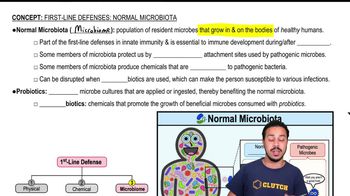
Normal microbiota are the microorganisms that typically reside on or within the human body without causing disease. These microbes are influenced by host factors such as immune responses, nutrition, and environment, which help maintain a balanced relationship and prevent overgrowth or infection.
추천 영상:
가이드 코스
03:43
Normal Microbiota
관련 실천