Ch. 2 - Biochemistry Basics
Norman-McKay- Microbiology: Basic and Clinical Principles 2nd Edition
Norman-McKay2nd EditionMicrobiology: Basic and Clinical PrinciplesISBN: 9780137661619당신이 사용하는 게 아니라요?교과서 변경
1장, 문제 16

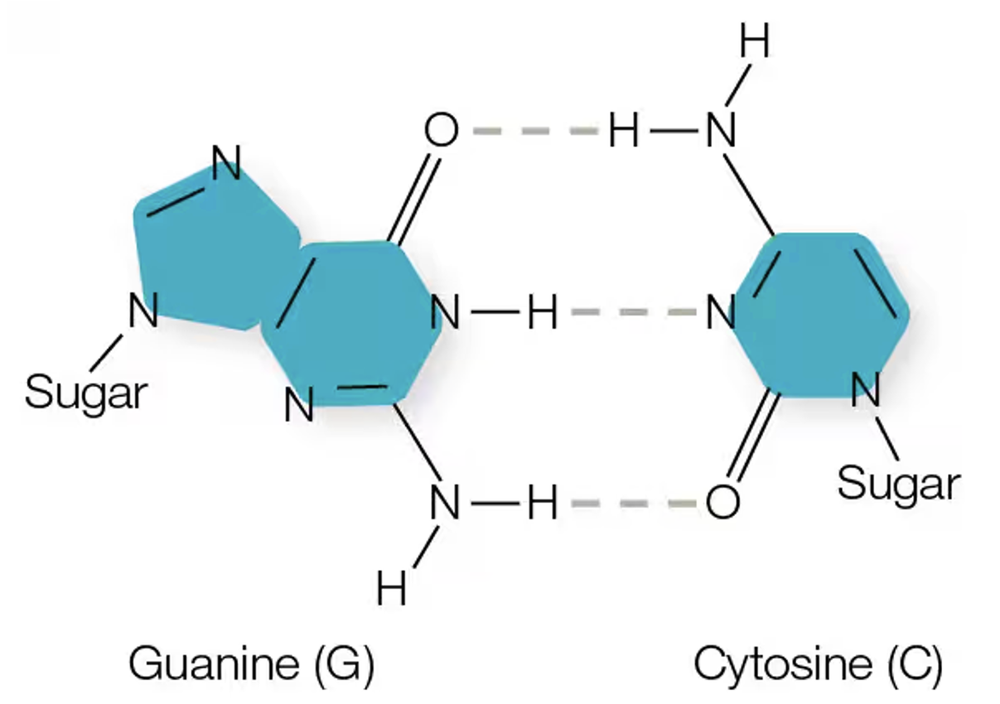
CIRCLE two covalent bonds and two hydrogen bonds in this image; label them. BOX a polar covalent bond.
Diagram of guanine and cytosine bases showing two covalent bonds circled, two hydrogen bonds circled, and one polar covalent bond boxed.

검증된 단계별 안내
1
Identify covalent bonds by looking for pairs of atoms sharing electrons within the same molecule. These bonds are typically represented by solid lines connecting atoms. Circle two such bonds where atoms share electrons equally or unequally.
Locate hydrogen bonds, which are weaker interactions often shown as dashed or dotted lines between a hydrogen atom attached to an electronegative atom (like oxygen or nitrogen) and another electronegative atom. Circle two of these hydrogen bonds and label them accordingly.
To find a polar covalent bond, look for a bond between two atoms with different electronegativities where electrons are shared unequally, causing partial charges. This bond is usually a solid line but with a dipole indicated (e.g., δ+ and δ-). Draw a box around one such bond and label it as a polar covalent bond.
Review the image carefully to ensure that the circled covalent bonds are within molecules, the circled hydrogen bonds are between molecules or within different parts of a large molecule, and the boxed polar covalent bond shows unequal electron sharing.
Label each circled and boxed bond clearly, using terms like 'Covalent Bond,' 'Hydrogen Bond,' and 'Polar Covalent Bond' to reinforce your understanding of the types of chemical interactions present.

비슷한 문제에 대한 검증된 영상 답변:

이 영상 해법은 위 문제에 도움이 된다고 튜터들이 추천한 것입니다.
영상 길이:
1m
도움이 되었나요?

주요 개념

질문에 올바르게 답하기 위해 반드시 이해해야 하는 핵심 개념들은 다음과 같습니다.

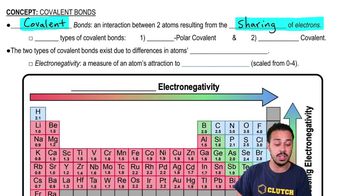
Covalent Bonds

Covalent bonds are strong chemical bonds formed by the sharing of electron pairs between atoms. They can be nonpolar, where electrons are shared equally, or polar, where electrons are shared unequally due to differences in electronegativity. These bonds form the backbone of molecules.
추천 영상:

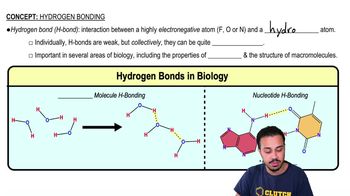
Hydrogen Bonds

Hydrogen bonds are weak, non-covalent interactions that occur when a hydrogen atom covalently bonded to an electronegative atom (like oxygen or nitrogen) is attracted to another electronegative atom. They play a key role in stabilizing structures like DNA and proteins.
추천 영상:
가이드 코스
05:03
Hydrogen Bonding

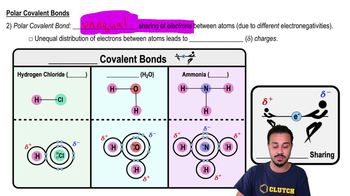
Polar Covalent Bonds

Polar covalent bonds occur when electrons are shared unequally between atoms with different electronegativities, creating partial positive and negative charges. This polarity influences molecular interactions and properties such as solubility and hydrogen bonding.
추천 영상:
가이드 코스
06:59
Polar Covalent Bonds