Ch. 2 - Biochemistry Basics
Norman-McKay- Microbiology: Basic and Clinical Principles 2nd Edition
Norman-McKay2nd EditionMicrobiology: Basic and Clinical PrinciplesISBN: 9780137661619당신이 사용하는 게 아니라요?교과서 변경
1장, 문제 11

The notation 18O denotes a(n)
a. Isomer.
b. Isotope.
c. Dipole.
d. Ion.
e. Reaction.

검증된 단계별 안내
1
Understand that the notation 18 O refers to an element of oxygen with a specific number associated with it.
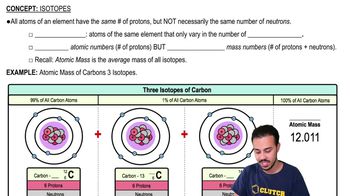
Recall that isotopes are atoms of the same element that have the same number of protons but different numbers of neutrons, resulting in different mass numbers.
Recognize that the number 18 in 18 O represents the mass number, which is the sum of protons and neutrons in the nucleus of the oxygen atom.
Compare this to the common oxygen isotope, which has a mass number of 16 (8 protons and 8 neutrons), so 18 O has 8 protons and 10 neutrons.
Conclude that 18 O is an isotope of oxygen, as it differs in neutron number but is the same element.

비슷한 문제에 대한 검증된 영상 답변:

이 영상 해법은 위 문제에 도움이 된다고 튜터들이 추천한 것입니다.
영상 길이:
1m
도움이 되었나요?

주요 개념

질문에 올바르게 답하기 위해 반드시 이해해야 하는 핵심 개념들은 다음과 같습니다.

Isotopes

Isotopes are variants of a chemical element that have the same number of protons but different numbers of neutrons, resulting in different atomic masses. For example, oxygen-18 (18O) has 8 protons and 10 neutrons, unlike the most common oxygen-16 isotope with 8 neutrons.
추천 영상:
06:50
Isotopes

Isomers

Isomers are molecules with the same molecular formula but different structural arrangements or spatial orientations. This concept applies mainly to organic compounds and does not relate to atomic notation like 18O.

Ions

Ions are atoms or molecules that have gained or lost electrons, resulting in a net electrical charge. The notation 18O does not indicate a charge, so it is not an ion.
추천 영상:
02:54
Bases