Ch. 4 - Introduction to Eukaryotic Cells
Norman-McKay- Microbiology: Basic and Clinical Principles 2nd Edition
Norman-McKay2nd EditionMicrobiology: Basic and Clinical PrinciplesISBN: 9780137661619당신이 사용하는 게 아니라요?교과서 변경
2장, 문제 8

The presence of which of the following would be helpful in distinguishing a prokaryote from a eukaryote? Select all that apply.
a. Peptidoglycan
b. Phospholipids
c. A cell wall
d. A nucleus
e. Chloroplasts
f. Ribosomes
g. Ability to carry out active transport
h. DNA

검증된 단계별 안내
1
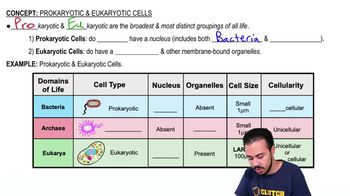
Step 1: Understand the fundamental differences between prokaryotes and eukaryotes. Prokaryotes are simpler cells without a nucleus or membrane-bound organelles, while eukaryotes have a nucleus and organelles like chloroplasts.
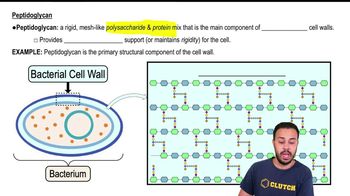
Step 2: Identify features unique to prokaryotes. For example, peptidoglycan is a component of bacterial cell walls, which are prokaryotic, but not found in eukaryotic cells.
Step 3: Recognize features unique to eukaryotes. The presence of a nucleus and chloroplasts are hallmark characteristics of eukaryotic cells.
Step 4: Evaluate common features that do not distinguish between the two, such as phospholipids (both have membranes), ribosomes (both have them, though structurally different), DNA (both have genetic material), and the ability to carry out active transport (both can do this).
Step 5: Based on this analysis, select all options that are distinctive markers for either prokaryotes or eukaryotes to effectively distinguish between them.

비슷한 문제에 대한 검증된 영상 답변:

이 영상 해법은 위 문제에 도움이 된다고 튜터들이 추천한 것입니다.
영상 길이:
2m

주요 개념

질문에 올바르게 답하기 위해 반드시 이해해야 하는 핵심 개념들은 다음과 같습니다.

Cellular Structure Differences Between Prokaryotes and Eukaryotes

Prokaryotes lack membrane-bound organelles such as a nucleus and chloroplasts, which are present in eukaryotes. This fundamental difference helps distinguish the two cell types, as prokaryotes have a simpler internal structure without compartmentalization.
추천 영상:
05:54
Prokaryotic & Eukaryotic Cells

Presence of Peptidoglycan in Cell Walls

Peptidoglycan is a unique component of bacterial cell walls, found only in prokaryotes. Eukaryotic cells, if they have cell walls, do not contain peptidoglycan, making it a key marker for identifying prokaryotic cells.
추천 영상:
01:58
Peptidoglycan

Membrane Components and Transport Mechanisms

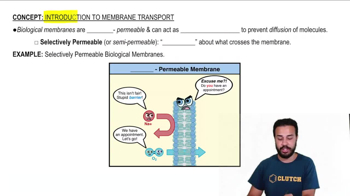
Both prokaryotes and eukaryotes have phospholipid membranes and ribosomes, and both can perform active transport. These features are not useful for distinguishing between the two, as they are common to both cell types.
추천 영상:
03:00
Introduction to Membrane Transport