Ch. 9 - Principles of Infectious Disease and Epidemiology
Norman-McKay- Microbiology: Basic and Clinical Principles 2nd Edition
Norman-McKay2nd EditionMicrobiology: Basic and Clinical PrinciplesISBN: 9780137661619당신이 사용하는 게 아니라요?교과서 변경
5장, 문제 2

Indicate the true statements and then correct the false statements, so they are true.
a. Zoonotic diseases pass from humans to animals.
b. Communicable diseases spread from person to person.
c. Noncommunicable diseases are contagious.
d. Koch’s postulates of disease are mainly used to study noninfectious diseases.

검증된 단계별 안내
1
Step 1: Analyze statement (a): 'Zoonotic diseases pass from humans to animals.' Understand that zoonotic diseases are infections that are transmitted from animals to humans, not the other way around. Therefore, this statement is false and should be corrected to: 'Zoonotic diseases pass from animals to humans.'
Step 2: Analyze statement (b): 'Communicable diseases spread from person to person.' Recognize that communicable diseases are indeed infectious diseases that can be transmitted directly or indirectly between people. This statement is true and requires no correction.
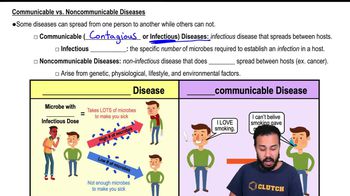
Step 3: Analyze statement (c): 'Noncommunicable diseases are contagious.' Recall that noncommunicable diseases are not infectious and cannot be transmitted between people, so they are not contagious. This statement is false and should be corrected to: 'Noncommunicable diseases are not contagious.'
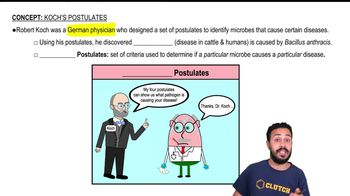
Step 4: Analyze statement (d): 'Koch’s postulates of disease are mainly used to study noninfectious diseases.' Remember that Koch’s postulates are a set of criteria used to establish the causative relationship between a microbe and an infectious disease. Therefore, this statement is false and should be corrected to: 'Koch’s postulates of disease are mainly used to study infectious diseases.'
Step 5: Summarize the corrections and confirm understanding of key microbiology concepts: zoonotic diseases transmission direction, definition of communicable and noncommunicable diseases, and the purpose of Koch’s postulates.

비슷한 문제에 대한 검증된 영상 답변:

이 영상 해법은 위 문제에 도움이 된다고 튜터들이 추천한 것입니다.
영상 길이:
4m

주요 개념

질문에 올바르게 답하기 위해 반드시 이해해야 하는 핵심 개념들은 다음과 같습니다.

Zoonotic Diseases

Zoonotic diseases are infections that are transmitted from animals to humans, not the other way around. These diseases can be caused by viruses, bacteria, or parasites and often involve close contact between humans and animals, such as rabies or Lyme disease.
추천 영상:
04:57
Communicable vs. Noncommunicable Diseases

Communicable vs Noncommunicable Diseases

Communicable diseases are infectious illnesses that spread from one person to another through direct or indirect contact. Noncommunicable diseases, in contrast, are not contagious and cannot be transmitted between people; examples include diabetes and cancer.
추천 영상:
04:57
Communicable vs. Noncommunicable Diseases

Koch’s Postulates

Koch’s postulates are a set of criteria used to establish a causative relationship between a microorganism and an infectious disease. They are primarily applied to study infectious diseases, not noninfectious conditions, by isolating and identifying the pathogen responsible.
추천 영상:
01:36
Koch's Postulates