
Ch. 10 - Classification of Microorganisms
Tortora - Microbiology: An Introduction 14th Edition
Tortora14th EditionMicrobiology: An IntroductionISBN: 9780138200398당신이 사용하는 게 아니라요?교과서 변경
6장, 문제 8

Use the following choices to answer questions 7 and 8.
a. Animalia
b. Fungi
c. Plantae
d. Bacillota (gram-positive bacteria)
e. Pseudomonadota (gram-negative bacteria)
Into which group would you place a photosynthetic organism that lacks a nucleus and has a thin peptidoglycan wall surrounded by an outer membrane?

검증된 단계별 안내
1
Identify the key characteristics of the organism described: it is photosynthetic, lacks a nucleus, and has a thin peptidoglycan wall surrounded by an outer membrane.
Recall that organisms lacking a nucleus are prokaryotes, which excludes groups Animalia, Fungi, and Plantae because they are eukaryotic.
Understand that the presence of a thin peptidoglycan layer surrounded by an outer membrane is characteristic of gram-negative bacteria.
Recognize that photosynthetic prokaryotes with these cell wall features are typically classified under Pseudomonadota (gram-negative bacteria).
Match the organism's features to the correct group from the choices provided, which is Pseudomonadota (gram-negative bacteria).

비슷한 문제에 대한 검증된 영상 답변:

이 영상 해법은 위 문제에 도움이 된다고 튜터들이 추천한 것입니다.

주요 개념

질문에 올바르게 답하기 위해 반드시 이해해야 하는 핵심 개념들은 다음과 같습니다.

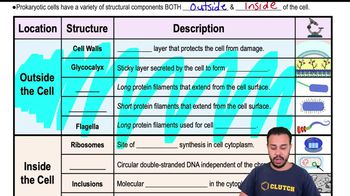
Prokaryotic Cell Structure

Prokaryotic cells lack a nucleus and membrane-bound organelles. Their genetic material is free-floating in the cytoplasm. Understanding this helps distinguish prokaryotes from eukaryotes, which have a defined nucleus.
추천 영상:
05:59
Overview of Prokaryotic Cell Structure

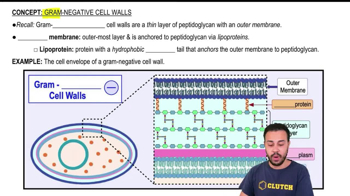
Gram-negative Bacterial Cell Wall

Gram-negative bacteria have a thin peptidoglycan layer located between an inner cytoplasmic membrane and an outer membrane containing lipopolysaccharides. This structure differs from gram-positive bacteria, which have a thick peptidoglycan wall but no outer membrane.
추천 영상:
3:04
Gram-Negative Cell Walls

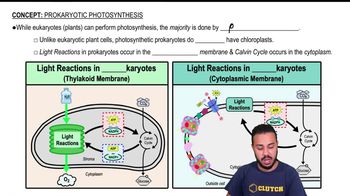
Photosynthetic Prokaryotes

Some prokaryotes, like cyanobacteria, perform photosynthesis despite lacking a nucleus. They contain pigments such as chlorophyll and have cell walls typical of gram-negative bacteria, enabling them to produce energy from sunlight.
추천 영상:
02:42
Prokaryotic Photosynthesis
관련 실천
교과서 질문

Use the following choices to answer questions 7 and 8.

a. Animalia

b. Fungi

c. Plantae

d. Bacillota (gram-positive bacteria)

e. Pseudomonadota (gram-negative bacteria)

Into which group would you place a multicellular organism that has a mouth and lives inside the human liver?

846
views
교과서 질문

The wall-less mycoplasmas are considered to be related to gram-positive bacteria. Which of the following would provide the most compelling evidence for this?

a. They share common rRNA sequences.

b. Some gram-positive bacteria and some mycoplasmas produce catalase.

c. Both groups are prokaryotic.

d. Some gram-positive bacteria and some mycoplasmas have coccus-shaped cells.

e. Both groups contain human pathogens.

1539
views
교과서 질문

Use the following choices to answer questions 9 and 10.

1. 9 + 2 flagella

2. 70s ribosome

3. fimbria

4. nucleus

5. peptidoglycan

6. plasma membrane

Which is (are) found only in prokaryotes?

a. 1,4,6

b. 3,5

c. 1,2

d. 4

e. 2,4,5

1461
views
교과서 질문

You could identify an unknown bacterium by all of the following except

a. hybridizing a DNA probe from a known bacterium with the unknown’s DNA.

b. making a fatty acid profile of the unknown.

c. specific antiserum agglutinating the unknown.

d. ribosomal RNA sequencing.

e. percentage of guanine + cytosine.

1599
views
교과서 질문

Use the following choices to answer questions 9 and 10.

1. 9 + 2 flagella

2. 70s ribosome

3. fimbria

4. nucleus

5. peptidoglycan

6. plasma membrane

Which is (are) found in all three domains?

a. 2,6

b. 5

c. 2,4,6

d. 1,3,5

e. all six

901
views