Ch. 14 - Principles of Disease and Epidemiology
Tortora - Microbiology: An Introduction 14th Edition
Tortora14th EditionMicrobiology: An IntroductionISBN: 9780138200398당신이 사용하는 게 아니라요?교과서 변경
10장, 문제 10

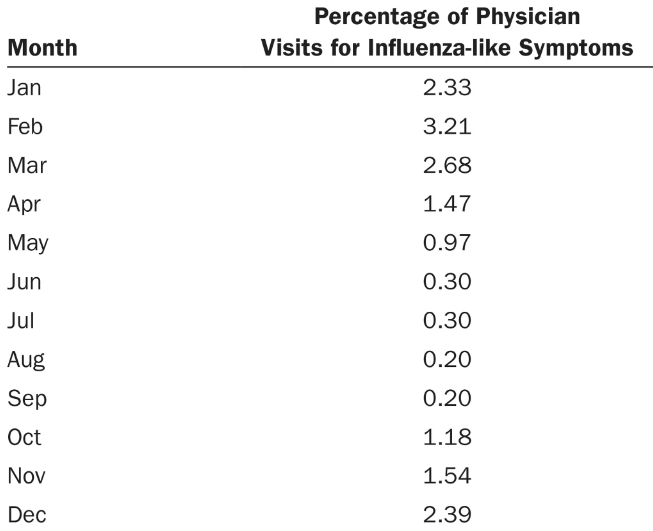
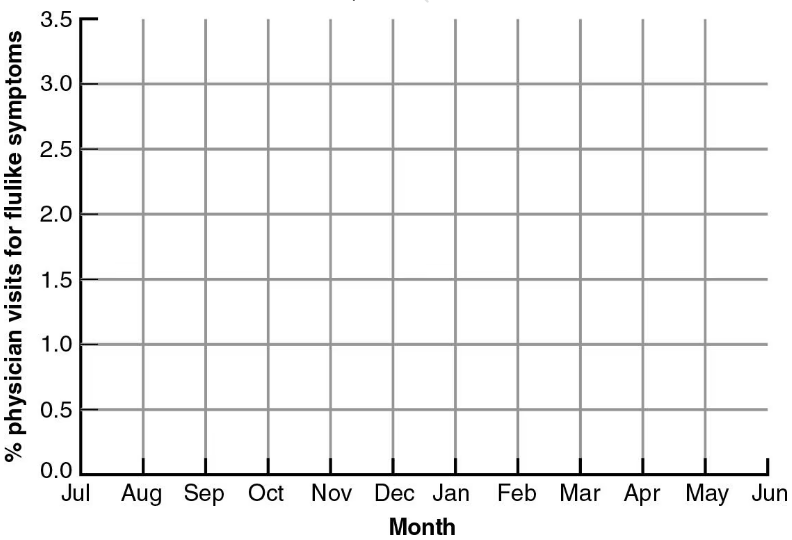
Using the following data, draw a graph showing the incidence of influenza during a typical year. Indicate the endemic and epidemic levels.
Table showing monthly percentages of physician visits for influenza-like symptoms, highlighting seasonal incidence trends.
Graph showing monthly percentage of physician visits for flu-like symptoms with endemic and epidemic levels indicated.

검증된 단계별 안내
1
Identify the data points provided for the incidence of influenza throughout the year. These data points typically represent the number of cases or incidence rate for each time period (e.g., weeks or months).
Plot the incidence data on a graph with time (weeks or months) on the x-axis and the number of influenza cases or incidence rate on the y-axis. Make sure to label both axes clearly.
Determine the endemic level by calculating the baseline incidence of influenza, which is the average number of cases during non-peak periods. This can be done by averaging the incidence values during months with low influenza activity.
Identify the epidemic level by finding the threshold above which the incidence is considered unusually high. This is often set at a certain number of standard deviations above the endemic level or based on historical epidemic data.
On the graph, draw a horizontal line representing the endemic level and another line above it representing the epidemic threshold. Highlight the periods where the incidence exceeds the epidemic level to indicate epidemic outbreaks.

비슷한 문제에 대한 검증된 영상 답변:

이 영상 해법은 위 문제에 도움이 된다고 튜터들이 추천한 것입니다.
영상 길이:
2m

주요 개념

질문에 올바르게 답하기 위해 반드시 이해해야 하는 핵심 개념들은 다음과 같습니다.

Incidence of Disease

Incidence refers to the number of new cases of a disease occurring in a specific population during a defined time period. It helps measure how frequently influenza appears over the year, which is essential for plotting the graph accurately.
추천 영상:
04:57
Communicable vs. Noncommunicable Diseases

Endemic and Epidemic Levels

Endemic level is the constant presence of a disease within a population at a baseline rate, while an epidemic level indicates a sudden increase in cases above this baseline. Identifying these levels on the graph shows normal versus outbreak conditions.
추천 영상:
03:00
Substrate-Level Phosphorylation

Graphical Representation of Epidemiological Data

Plotting incidence data on a graph involves using time (e.g., months) on the x-axis and number of cases on the y-axis. This visual tool helps illustrate trends, seasonal patterns, and deviations such as epidemics in influenza occurrence.
추천 영상:
07:21
Variables
관련 실천
교과서 질문

An encapsulated bacterium can be virulent because the capsule

a. resists phagocytosis.

b. is an endotoxin.

c. destroys host tissues.

d. kills host cells.

e. has no effect; because many pathogens do not have capsules, capsules do not contribute to virulence.

1392
views
교과서 질문

Name one fungus and one protozoan that can cause genital system infections. What symptoms would lead you to suspect these infections?

1065
views
교과서 질문

Use the following information to answer questions 8–10.

A Maryland woman was hospitalized with dehydration. V. cholerae and Plesiomonas shigelloides were isolated from the patient, who had neither traveled outside the United States nor eaten raw shellfish during the preceding month. The patient had attended a party before hospitalization. Two other people at the party had acute diarrheal illness and elevated levels of serum antibodies against Vibrio. Everyone at the party ate crabs and rice pudding with coconut milk. Crabs left over from this party were served at a second party. One of the people at the second party had onset of mild diarrhea; specimens from of these people were negative for vibriocidal antibodies.

The source of the disease was

a. Plesiomonas shigelloides.

b. crabs.

c. V. cholerae.

d. coconut milk.

e. rice.

627
views
교과서 질문

Use the following information to answer questions 8–10.

A Maryland woman was hospitalized with dehydration. V. cholerae and Plesiomonas shigelloides were isolated from the patient, who had neither traveled outside the United States nor eaten raw shellfish during the preceding month. The patient had attended a party before hospitalization. Two other people at the party had acute diarrheal illness and elevated levels of serum antibodies against Vibrio. Everyone at the party ate crabs and rice pudding with coconut milk. Crabs left over from this party were served at a second party. One of the people at the second party had onset of mild diarrhea; specimens from of these people were negative for vibriocidal antibodies.

This is an example of

a. vehicle transmission.

b. airborne transmission.

c. transmission by fomites.

d. direct contact transmission.

e. healthcare-associated transmission.

852
views
교과서 질문

This microbe is acquired by humans as infants and is essential for good health. Acquiring a closely related strain causes severe stomach cramps, bloody diarrhea, and vomiting. What is the microbe?

1503
views