Ch. 17 - Adaptive Immunity: Specific Defenses of the Host
Tortora - Microbiology: An Introduction 14th Edition
Tortora14th EditionMicrobiology: An IntroductionISBN: 9780138200398당신이 사용하는 게 아니라요?교과서 변경
13장, 문제 9

How can a human make 100 billion different antibodies with only 25,000 different genes?

검증된 단계별 안내
1
Understand that the human genome contains approximately 25,000 genes, which is far fewer than the number of different antibodies the immune system can produce (about 100 billion). This discrepancy is explained by the process of antibody gene rearrangement and diversification.
Learn about V(D)J recombination, a mechanism in B cells where variable (V), diversity (D), and joining (J) gene segments are randomly combined to create a vast array of unique variable regions in antibodies. This combinatorial joining greatly increases diversity beyond the number of genes.
Recognize that additional diversity arises from junctional diversity, where nucleotides are added or deleted at the joining sites of V, D, and J segments during recombination, further increasing the variety of possible antibodies.
Consider somatic hypermutation, a process occurring after antigen exposure where point mutations are introduced at a high rate in the variable region genes of activated B cells, refining and expanding antibody specificity.
Combine all these mechanisms—combinatorial joining, junctional diversity, and somatic hypermutation—to understand how a limited number of genes can generate an enormous repertoire of antibodies capable of recognizing a vast array of antigens.

비슷한 문제에 대한 검증된 영상 답변:

이 영상 해법은 위 문제에 도움이 된다고 튜터들이 추천한 것입니다.
영상 길이:
3m
도움이 되었나요?

주요 개념

질문에 올바르게 답하기 위해 반드시 이해해야 하는 핵심 개념들은 다음과 같습니다.

V(D)J Recombination

V(D)J recombination is a process in developing B cells where variable (V), diversity (D), and joining (J) gene segments are randomly combined to create diverse antibody genes. This genetic shuffling allows a limited number of gene segments to generate a vast array of unique antibodies.
추천 영상:
03:41
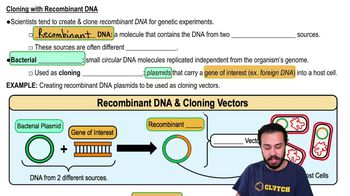
Cloning with Recombinant DNA

Somatic Hypermutation

Somatic hypermutation introduces point mutations at a high rate in the variable regions of antibody genes after antigen exposure. This process refines antibody affinity and increases diversity beyond the initial gene recombination, enabling the immune system to adapt to various pathogens.
추천 영상:
03:58
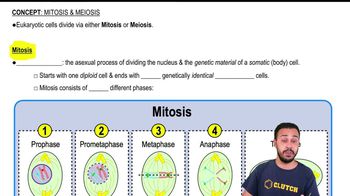
Mitosis

Combinatorial and Junctional Diversity

Combinatorial diversity arises from different combinations of heavy and light chain gene segments, while junctional diversity results from the addition or deletion of nucleotides at gene segment junctions during recombination. Together, these mechanisms greatly expand the antibody repertoire.
추천 영상:
05:42
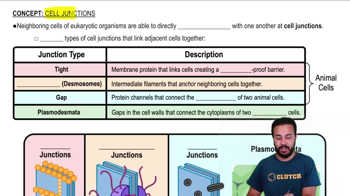
Cell Junctions