

Ch. 25 - Microbial Diseases of the Digestive System
Tortora - Microbiology: An Introduction 14th Edition
Tortora14th EditionMicrobiology: An IntroductionISBN: 9780138200398당신이 사용하는 게 아니라요?교과서 변경
21장, 문제 8

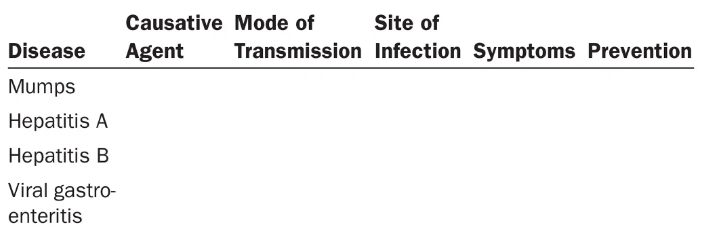
Complete the following table:
Blank table with columns for disease, causative agent, transmission mode, infection site, symptoms, and prevention, listing four viral diseases.

검증된 단계별 안내
1
Step 1: Identify the causative agent for each disease. For example, Mumps is caused by the Mumps virus, Hepatitis A by the Hepatitis A virus, Hepatitis B by the Hepatitis B virus, and Viral gastroenteritis can be caused by several viruses such as Norovirus or Rotavirus.
Step 2: Determine the mode of transmission for each disease. Mumps is typically transmitted via respiratory droplets, Hepatitis A through the fecal-oral route (contaminated food or water), Hepatitis B through blood and bodily fluids, and Viral gastroenteritis mainly through the fecal-oral route or contaminated food and water.
Step 3: Identify the primary site of infection for each disease. Mumps primarily infects the salivary glands, Hepatitis A and B infect the liver, and Viral gastroenteritis affects the gastrointestinal tract.
Step 4: List common symptoms associated with each disease. Mumps symptoms include swollen salivary glands and fever; Hepatitis A and B symptoms include jaundice, fatigue, and abdominal pain; Viral gastroenteritis symptoms include diarrhea, vomiting, and stomach cramps.
Step 5: Describe prevention methods for each disease. Mumps prevention includes vaccination (MMR vaccine); Hepatitis A prevention involves vaccination and good hygiene; Hepatitis B prevention includes vaccination and avoiding contact with infected bodily fluids; Viral gastroenteritis prevention focuses on good hygiene, safe food and water practices, and sometimes vaccination (e.g., Rotavirus vaccine).

비슷한 문제에 대한 검증된 영상 답변:

이 영상 해법은 위 문제에 도움이 된다고 튜터들이 추천한 것입니다.
영상 길이:
2m
도움이 되었나요?

주요 개념

질문에 올바르게 답하기 위해 반드시 이해해야 하는 핵심 개념들은 다음과 같습니다.

Viral Diseases and Their Causative Agents

Understanding viral diseases requires identifying the specific virus responsible for each illness. For example, mumps is caused by the mumps virus, Hepatitis A by the Hepatitis A virus, Hepatitis B by the Hepatitis B virus, and viral gastroenteritis by various viruses like norovirus or rotavirus. Knowing the causative agent helps in diagnosis and treatment.
추천 영상:
05:12
Persistent Viral Infections

Modes of Transmission

Transmission mode explains how a virus spreads from one host to another. This can include direct contact, airborne droplets, fecal-oral route, or bloodborne pathways. For instance, Hepatitis A spreads mainly via the fecal-oral route, while Hepatitis B is transmitted through blood and bodily fluids. Recognizing transmission helps in controlling outbreaks.
추천 영상:
04:23
Transmission Electron Microscope (TEM)

Site of Infection, Symptoms, and Prevention

Each viral disease targets specific body sites, causing characteristic symptoms; mumps affects salivary glands causing swelling, Hepatitis viruses target the liver causing jaundice, and viral gastroenteritis affects the intestines causing diarrhea. Prevention strategies include vaccination, hygiene, and avoiding exposure to infectious agents, which are crucial for disease control.
추천 영상:
03:29
Acute Viral Infections