
Ch. 2 - Chemical Principles
Tortora - Microbiology: An Introduction 14th Edition
Tortora14th EditionMicrobiology: An IntroductionISBN: 9780138200398당신이 사용하는 게 아니라요?교과서 변경
2장, 문제 2

Diagram the electronic configuration of a carbon atom.

검증된 단계별 안내
1
Identify the atomic number of carbon, which is 6. This means a carbon atom has 6 electrons to arrange in its electron configuration.
Recall the order of filling electron orbitals based on the Aufbau principle: 1s, 2s, 2p, 3s, and so on. Electrons fill the lowest energy orbitals first.
Start placing electrons in the orbitals: fill the 1s orbital first with 2 electrons, then the 2s orbital with 2 electrons.
Next, place the remaining 2 electrons in the 2p orbital. Since 2p can hold up to 6 electrons, place these 2 electrons singly in separate 2p orbitals following Hund's rule.
Draw the diagram showing the orbitals as boxes or lines, and represent electrons as arrows (↑ or ↓) indicating their spin, filling 1s with two arrows, 2s with two arrows, and 2p with two single arrows in separate boxes.

비슷한 문제에 대한 검증된 영상 답변:

이 영상 해법은 위 문제에 도움이 된다고 튜터들이 추천한 것입니다.
도움이 되었나요?

주요 개념

질문에 올바르게 답하기 위해 반드시 이해해야 하는 핵심 개념들은 다음과 같습니다.

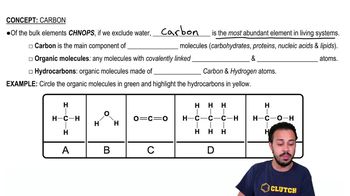
Atomic Structure of Carbon

Carbon has an atomic number of 6, meaning it contains 6 protons and, in a neutral atom, 6 electrons. Understanding the number of electrons is essential to determine how they are arranged in energy levels or shells around the nucleus.
추천 영상:
04:19
Carbon

Electron Configuration

Electron configuration describes the distribution of electrons in an atom's orbitals or shells. For carbon, electrons fill the lowest energy levels first, following the Aufbau principle, resulting in the configuration 1s² 2s² 2p².
추천 영상:
03:08
Electron Microscopes

Energy Levels and Subshells

Electrons occupy energy levels (shells) and subshells (s, p, d, f) based on increasing energy. Carbon's electrons fill the first shell (1s) and the second shell's s and p subshells, which is crucial for understanding its chemical bonding and reactivity.
추천 영상:
05:04
Introduction to Energy
관련 실천
교과서 질문

Radioisotopes are frequently used to label molecules in a cell. The fate of atoms and molecules in a cell can then be followed. This process is the basis for the following question.


If Pseudomonas bacteria are supplied with radioactively labeled cytosine, after a 24-hour incubation period this cytosine would most likely be found in the cells’

a. Carbohydrates.

b. DNA.

c. Lipids.

d. Water.

e. Proteins.

788
views
교과서 질문

What type of bond holds the following atoms together?

a. Li+ and Cl- in LiCl

b. Carbon and oxygen atoms in methanol

c. Oxygen atoms in O2

d. A hydrogen atom of one nucleotide to a nitrogen or oxygen atom of another nucleotide in:

1446
views
교과서 질문

Radioisotopes are frequently used to label molecules in a cell. The fate of atoms and molecules in a cell can then be followed. This process is the basis for the following question.


If E. coli were grown in a medium containing the radioactive isotope 32P, the 32P would be found in all of the following molecules of the cell except

a. ATP.

b. Carbohydrates.

c. DNA.

d. Plasma membrane.

e. Complex lipids.

998
views
교과서 질문

What is a chemical element?

1006
views
교과서 질문

The optimum pH of Acidithiobacillus bacteria (pH 3) is _______________ times more acid than blood (pH 7).

a. 4

b. 10

c. 100

d. 1000

e. 10,000

1413
views
교과서 질문

Radioisotopes are frequently used to label molecules in a cell. The fate of atoms and molecules in a cell can then be followed. This process is the basis for the following question.


Assume E. coli bacteria are grown in a nutrient medium containing the radioisotope 16N. After a 48-hour incubation period, the 16N would most likely be found in the E. coli’s

a. Carbohydrates.

b. Lipids.

c. Proteins.

d. Water.

e. None of the above

1367
views