Ch. 4 - Functional Anatomy of Prokaryotic and Eukaryotic Cells
Tortora - Microbiology: An Introduction 14th Edition
Tortora14th EditionMicrobiology: An IntroductionISBN: 9780138200398당신이 사용하는 게 아니라요?교과서 변경
4장, 문제 4

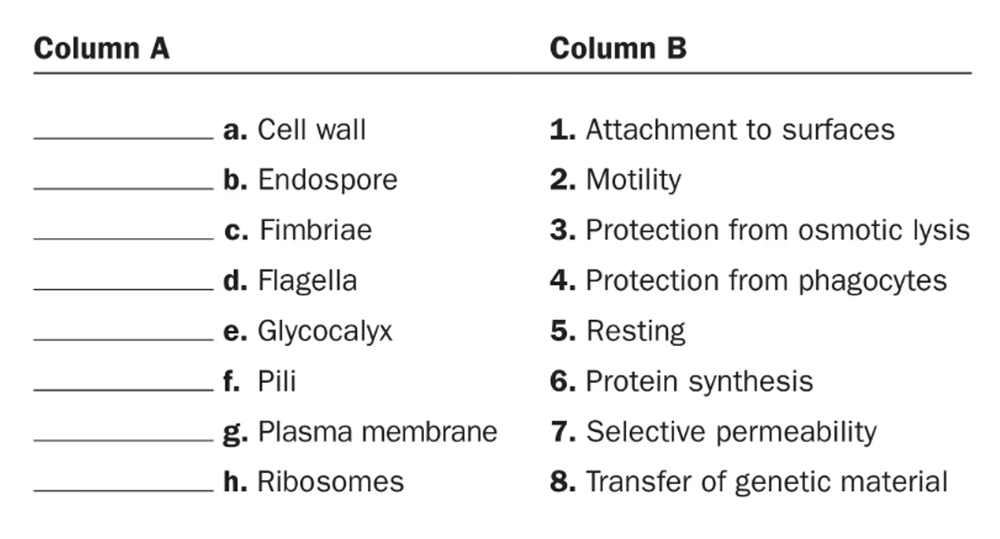
Match the structures in column A to their functions in column B.
Matching exercise listing prokaryotic cell structures in column A and their functions in column B to pair correctly.

검증된 단계별 안내
1
Identify each structure listed in column A by recalling its key characteristics and role in microbiology. For example, if the structure is a bacterial flagellum, recognize it as a motility organelle.
Review the functions listed in column B carefully, understanding what each function entails. For instance, functions might include motility, protection, genetic exchange, or nutrient absorption.
Match each structure to the function that best corresponds to its known biological role. For example, match the flagellum to motility, the capsule to protection against host defenses, and pili to genetic exchange or attachment.
Use elimination to help with difficult matches by ruling out functions that clearly do not fit a given structure based on your microbiology knowledge.
Double-check your matches by considering the overall context and ensuring that each structure-function pair makes sense biologically and aligns with standard microbiology concepts.

비슷한 문제에 대한 검증된 영상 답변:

이 영상 해법은 위 문제에 도움이 된다고 튜터들이 추천한 것입니다.
영상 길이:
2m
도움이 되었나요?

주요 개념

질문에 올바르게 답하기 위해 반드시 이해해야 하는 핵심 개념들은 다음과 같습니다.

Microbial Cell Structures

Understanding the various structures of microbial cells, such as the cell wall, plasma membrane, flagella, pili, and ribosomes, is essential. Each structure has a specific role in the cell's survival, movement, or reproduction, which helps in correctly matching them to their functions.
추천 영상:
가이드 코스
05:59
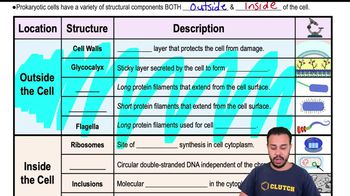
Overview of Prokaryotic Cell Structure

Functions of Microbial Cell Components

Each microbial structure performs distinct functions like protection, nutrient transport, motility, or protein synthesis. Knowing these functions allows one to link the physical structure to its biological role, facilitating accurate matching in the question.
추천 영상:

Structure-Function Relationship in Microbiology

The principle that the shape and composition of a microbial structure determine its function is key. Recognizing this relationship helps in predicting the function based on structural features, which is critical for answering matching questions involving cell components.
추천 영상:
가이드 코스
05:59
Symbiotic Relationships
관련 실천
교과서 질문

Endospore formation is called (a) ________. It is initiated by (b) ________. Formation of a new cell from an endospore is called (c) ________. This process is triggered by (d) ________.

1497
views

교과서 질문

Draw the bacterial shapes listed in (a), (b), and (c). Then draw the shapes in (d), (e), and (f), showing how they are special conditions of a, b, and c, respectively.

a. Spiral

b. Bacillus

c. Coccus

d. Spirochetes

e. Staphylococci

f. Streptobacilli

1572
views
교과서 질문

Use the following choices to answer the following question.

a. No change will result; the solution is isotonic.

b. Water will move into the cell.

c. Water will move out of the cell.

d. The cell will undergo osmotic lysis.

e. Sucrose will move into the cell from an area of higher concentration to one of lower concentration.


Which statement best describes what happens when a gram-negative bacterium is placed in distilled water and penicillin?

764
views
교과서 질문

Which of the following statements best describes what happens to a cell exposed to polymyxins that destroy phospholipids?

a. In an isotonic solution, nothing will happen.

b. In a hypotonic solution, the cell will lyse.

c. Water will move into the cell.

d. Intracellular contents will leak from the cell.

e. Any of the above might happen.

1392
views
교과서 질문

Use the following choices to answer the following question.

a. No change will result; the solution is isotonic.

b. Water will move into the cell.

c. Water will move out of the cell.

d. The cell will undergo osmotic lysis.

e. Sucrose will move into the cell from an area of higher concentration to one of lower concentration.


Which statement best describes what happens when a gram-positive bacterium is placed in an aqueous solution of lysozyme and 10% sucrose?

870
views
교과서 질문

Why is an endospore called a resting structure? Of what advantage is an endospore to a bacterial cell?

1828
views